Article
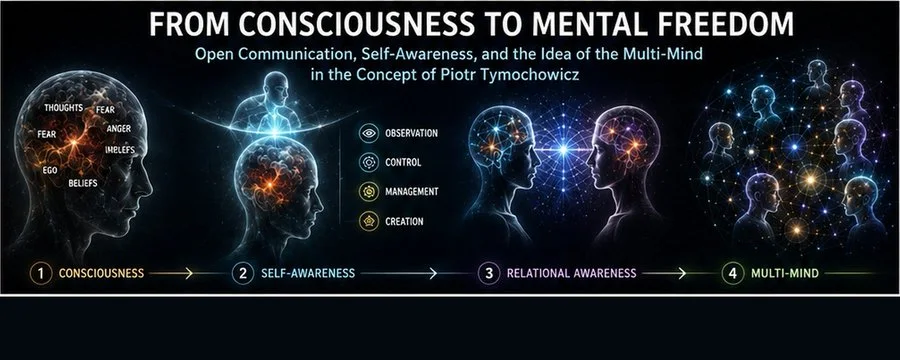
FROM CONSCIOUSNESS TO MENTAL FREEDOM
FROM CONSCIOUSNESS TO MENTAL FREEDOM
Open Communication, Self-Awareness, and the Idea of the Multi-Mind in Piotr Tymochowicz’s Framework
Adapted by Roman Grelewicz — participant in Piotr Tymochowicz’s seminars
In this article, I present Piotr Tymochowicz’s framework as I understand it after becoming familiar with his way of thinking, studying Theory Q, and taking part in many hours of conversations devoted to consciousness, self-awareness, and Open Communication. This is not a textbook of academic psychology, nor is it an attempt to present every claim below as a scientifically established fact. Some elements can be compared with research on metacognition, self-regulation, reflexivity, and perspective-taking; others are Tymochowicz’s own hypotheses derived from Theory Q.
Yet the most intriguing question — the one from which everything begins — is this: what if the greatest human problem is not what we think, but the fact that, without noticing it, we treat every thought, emotion, and interpretation as part of who we are?
1. The Deepest Identification: “My Consciousness Is Me”
We say: “I’m stressed,” “I’m jealous,” “I’m devastated,” “I’m furious,” “I’m hopeless.” Our language reveals something far deeper than grammar. We very easily identify ourselves with the current state of our own mind. A thought becomes “me,” an emotion becomes “me,” fear becomes “me,” a belief becomes “me,” and the story I tell myself begins to look like an objective description of reality.
In Piotr Tymochowicz’s framework, this is precisely where the fundamental problem lies. Consciousness is highly suggestive. What we experience from within has a special status of truth for us. If I am angry, my anger seems justified. If I feel wronged, the story of my injury seems obvious. If I dislike someone, I quickly find arguments explaining why that person truly does not deserve my sympathy. If I love, I idealize. If I hate, I demonize. If I am afraid, the world suddenly fills with threats.
Consciousness, then, is not an impartial reporter of reality. It participates in events. That is why the first step is not to replace one thought with another. It is to change the point from which we observe.
2. The Observer Appears
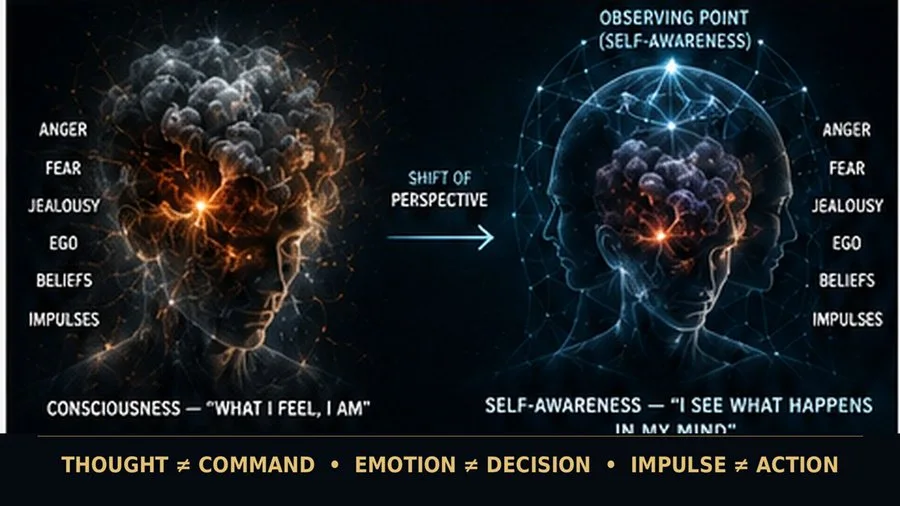
Imagine that instead of saying, “I am furious,” I can think: “I notice very intense anger arising in my mind.” On the surface, only the wording has changed. In reality, the geometry of the whole situation has shifted. If I can observe anger, then there is both the anger being observed and something that is observing it.
Tymochowicz calls this second level self-awareness. Consciousness experiences; self-awareness knows that it is experiencing. Consciousness thinks; self-awareness can observe the process of thinking. Consciousness is afraid; self-awareness can notice: “My mind is generating fear right now.” Consciousness wants to attack; self-awareness can see: “I have an impulse to attack.”
In that small gap between impulse and observer, choice begins to appear. A thought no longer automatically means action. An emotion is no longer an order. An impulse is no longer a decision.
I may think, “I should insult him,” but I do not have to insult him. I can feel jealousy, notice it, even speak about it, without allowing jealousy itself to make the decision. Put simply: a thought is a psychological event, not an instruction; an emotion is an experience, not a command; fear is information, not a dictator.
This is where what Tymochowicz calls mental freedom begins. It is not freedom from emotion, but freedom in relation to emotion.
3. The Fundamental Transformation
Occasionally observing ourselves is not yet a fundamental change. We all have moments when we think: “I probably overdid it,” “Why did I react like that?” or “Perhaps I’m not right after all.” These are brief flashes of reflection, after which we very often return to the old arrangement and once again become our anger, our fear, our righteousness, and our ego.
Tymochowicz therefore proposes reversing the reference point. Instead of living by the rule, “I am consciousness that occasionally becomes self-aware,” we can try to adopt a different stance: “I am grounded in self-awareness and I possess consciousness, which I can enter when I need to.”
This is what he calls the fundamental transformation.
It does not mean destroying consciousness. Emotions remain. Joy, love, sexuality, wonder, anger, and fear all remain. What changes is the relationship between the person and these states. In the old arrangement, emotion may govern the person. In the new one, the person tries to govern the relationship with the emotion.
Nor does this mean turning into a cold analyst. If I listen to music and feel deeply moved, I can immerse myself in that experience. If I look at an extraordinary landscape, I do not have to analyze my own wonder. Self-awareness is not a permanent laboratory. It is the ability to return to the observer’s position when that becomes genuinely useful.
4. Four Levels of Agency
As the framework develops, Tymochowicz distinguishes four levels in our relationship with our own mind: observation, control, management, and creation.
Observation says: “I can see my anger.” Control says: “I will not let it turn into aggression.” Management says: “I will decide what I want to do with this situation.” Creation asks: “What mental state, interpretation, or course of action do I want to create now?”
This is no longer merely a psychology of reaction; it becomes a psychology of agency. A human being is not only to respond to the world, but gradually to become the author and manager of his or her own response to it.
One of the characteristic ideas in this model is what Tymochowicz calls the “permission center.” It should not be understood as a specific, scientifically verified neuroanatomical center in the brain, but as a functional element of his model. The idea is simple: the appearance of an emotion is one thing; granting that emotion permission to take over is another.
I can say, “I am furious,” while also saying, “I do not give myself permission to humiliate this person.” I can feel fear and still decide that I do not want fear to make the decision for me.
This is fundamentally different from suppressing emotion. The message is not “I am not allowed to feel.” It is: “I am allowed to feel, but not every emotion must be given the right to act.”
5. Open Communication: Instead of Acting Out an Emotion, We Can Put It into Words
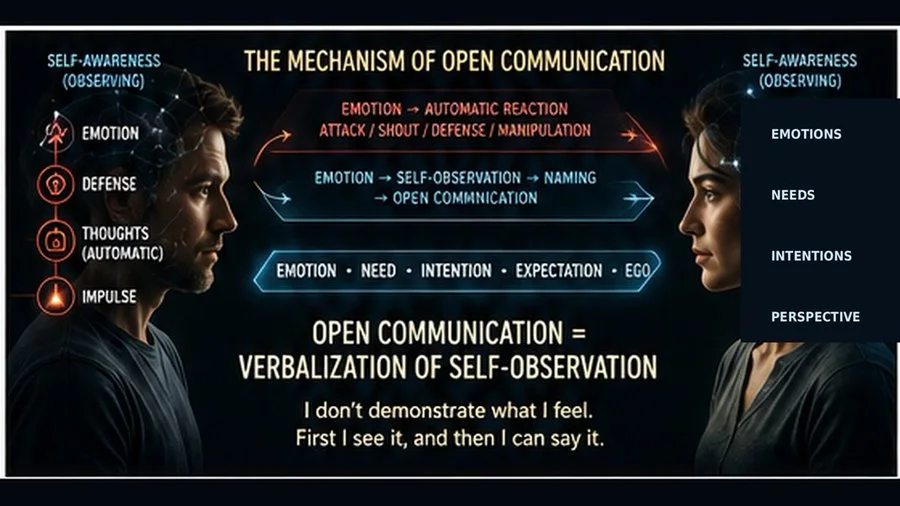
This is where Open Communication begins in earnest. Imagine that I am furious. I can shout, slam doors, insult someone, punish them with silence, or try to get even. But there is another possibility: I can say what is actually happening inside me.
“I am very angry right now. I even have an impulse to say something genuinely hurtful to you. I do not want to do that, but I want you to know what is happening inside me.”
The anger has been revealed, but it has not been converted into aggression. The emotion has not been denied; it has been described.
That is why one of Tymochowicz’s most important definitions can be stated this way:
Open Communication is the verbalization of self-observation.
I do not merely observe myself. I tell the other person what I have seen. I notice an emotion — I speak about the emotion. I notice an expectation — I reveal the expectation. I see a need — I name the need. I notice my ego — I can speak about it openly. I notice an attempt to manipulate — I can disclose that as well.
That changes communication radically.
6. Why Communication Technique Alone Is Not Enough
A person can be taught thirty rules of good communication. We can say: be empathetic, tell the truth, do not judge, do not manipulate, appreciate others, speak about emotions, respect boundaries, apologize, and express expectations clearly.
The problem is that technique used without a deeper change in the person remains technique. It can even become another tool of manipulation. Someone may learn the language of empathy in order to control other people more effectively. Beautiful words can be spoken while the other person is still treated as an object.
Tymochowicz therefore reverses the process. He does not begin by asking us to memorize dozens of behaviors. He begins by changing the point of observation.
If I truly begin to see my own manipulation, ego, fear, needs, and expectations, and then learn to speak about them, many of the principles of Open Communication begin to emerge spontaneously. Not because I memorized a manual, but because they became a logical consequence of self-awareness.
7. Truth as the Opposite of Manipulation
Manipulation requires two worlds: the one I show and the one I hide. I say, “Of course, do whatever you want,” while secretly hoping that the other person will feel guilty and do exactly what I want. I say, “I don’t care,” although I care deeply. I say, “I’m not jealous,” while spending the next half hour punishing someone with coldness.
Self-awareness allows us to notice the difference. I can then say: “I said I didn’t care, but I can see that it isn’t true. I care very much, and I think that is why I am trying to pretend that I don’t.”
This is Open Communication in one of its most radical forms. It is not about telling everything to everyone, nor about using “brutal honesty” as a weapon. It is about creating as much consistency as possible between what I see in myself and what I consciously choose to communicate.
8. The Ego Does Not Have to Die. It Has to Stop Being the Only Ruler
In many systems of personal development, the ego is presented as an enemy that must be destroyed. Tymochowicz proposes a more interesting solution. The ego remains. The problem is not that it exists; the problem arises when the ego becomes the only center of reference.
Then what matters most is my rightness, my image, my grievance, my status, and my advantage. Self-awareness allows me to see the ego as one element of the mind — and beside the ego, empathy can appear.
We do not have to choose between ego and empathy. We can have both ego and empathy.
I have the right to have my needs, but the other person has needs too. I have the right to defend my boundary, but the other person also has boundaries. I have the right to believe that I am right, yet sometimes the relationship may matter more than the triumph.
And here we reach one of the most powerful questions in the whole framework: being right — or preserving the relationship?
You can be right and destroy a relationship. You can win an argument and lose a person. Self-awareness makes it possible to ask: “What am I actually fighting for right now? Is this still about the issue, or is it simply about not losing face?”
Sometimes being right really does matter more. Sometimes we need to set a boundary, say “no,” or walk away. But very often we discover that we are not defending truth at all. We are defending our own ego.
9. Separate the Person from the Problem
This is one of the most practical consequences of the framework. A person did something wrong — that does not yet mean the person is bad. Someone said something foolish — that does not mean the person is foolish. A person made a mistake — the person is not the mistake.
Separating a person from a behavior allows us to preserve both truth and respect. I can say, “What you did hurt me deeply,” instead of “You are a monster.” I can say, “I think this decision is disastrous,” instead of “You are an idiot.”
This may look like a small linguistic distinction, but it changes the structure of conflict. The enemy is no longer the person. The problem becomes the problem.
10. The Other Person Is Not an Extra in My Film
When I am completely enclosed within my own consciousness, it is very easy to treat other people as elements of my world. The driver is supposed to take me somewhere, the employee is supposed to complete a task, my partner is supposed to meet my needs, my child is supposed to fulfill my expectations, the customer is supposed to buy.
The other person becomes a function.
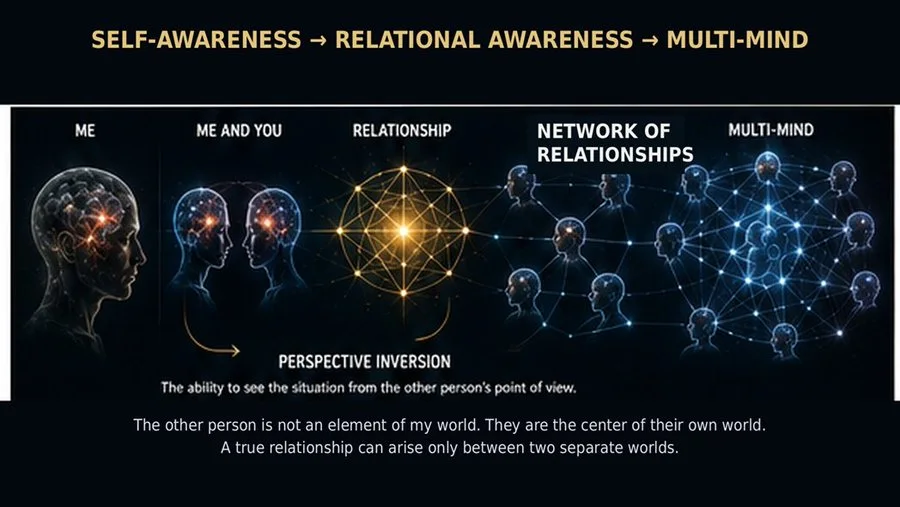
Self-awareness makes it possible to notice something obvious and yet profound: the other person also has an inner world. They are not an extra in my film. They are the central character in their own.
Their perspective may feel just as obvious to them as mine feels to me.
And this is where inversion enters the picture.
11. Inversion — Stepping, for a Moment, to the Other Side
Inversion can be understood most simply as an attempt to change the reference frame. I no longer ask only, “What do I think about you?” I try to see: “What might this situation look like from where you stand?”
Imagine two people standing opposite one another. Each points to their own right side, yet physically they point in opposite directions. Which one is right? Both of them — because “right” depends on the reference frame.
Many psychological conflicts can work in exactly the same way. I see disrespect; you see exhaustion. I see aggression; you see the defense of a boundary. I see betrayal; you see an attempt to save yourself.
This does not mean that every interpretation is equally true. It means only that before I declare my own perspective to be the only possible one, it is worth asking from what position the other person’s perspective may have arisen.
That is one of the foundations of empathy.
12. One Problem Does Not Have to Take Over an Entire Life
Tymochowicz also develops the idea of “parallel worlds,” understood psychologically rather than physically. Human life consists of many domains: family, work, creativity, health, friendship, love, rest, learning, and others.
The trouble begins when a disaster in one world takes possession of the whole mind. A conflict at work poisons time with the family; a breakup destroys the ability to work; one critical remark wipes out the joy of every other success.
Self-awareness can say: “Something very difficult is happening in this one area, but my life does not end with this area.”
This is not denial. It is a refusal to grant one problem a monopoly over the whole of psychological life.
13. Mind and Meta-Mind
In a more structured version of the framework, Tymochowicz introduces the concepts of mind and meta-mind. The mind includes our everyday psychological processes: thoughts, emotions, memory, experience, and both conscious and non-conscious processes. The meta-mind is the level whose central function is self-awareness.
We can therefore say that the mind produces experience, while the meta-mind can observe that experience and attempt to manage it.
But something else appears between them as well: an inner relationship.
And that raises an important question. If self-awareness is to function as a higher-order observer and regulator, should it treat the mind as an enemy?
According to Tymochowicz — no.
The mind should instead be cared for.
If it is afraid, its fear is worth seeing. If it suffers, there is no need to pretend that the suffering is not there. If it is exhausted, the exhaustion should be noticed. If it has a harmful mechanism, we can try to change it — but without starting a psychological civil war.
The most mature model of the inner relationship would therefore not be dictatorship, but partnership.
14. Self-Acceptance Is Not a Declaration of Perfection
When a person can gain some distance from their own mind, they can begin to speak about it much more honestly: “I like my mind. It is highly creative. In some situations it works brilliantly; in others it overdoes things. Sometimes it is easily influenced. Sometimes it multiplies problems. I am proud of some of its achievements, and there are other things I would like to change.”
Suddenly there is no need to choose between two extremes: self-glorification and self-belittlement.
Genuine self-acceptance does not have to sound like, “Everything about me is wonderful.” A far more mature version is: “I can look at myself without having to falsify the picture.”
Connected with this is Tymochowicz’s idea of auto-edification — the ability to acknowledge one’s own value without sliding into grandiosity. Not “I am the greatest,” but not “I am nobody” either. I know my strengths and do not have to be ashamed of them; I know my weaknesses and do not have to despise myself because of them.
Interestingly, a person who no longer has to fight constantly for a sense of personal value finds it much easier to recognize value in others. I do not have to make you smaller in order to make myself larger.
15. From the Relationship with Myself to the Relationship with Others
At this point the framework begins to form a kind of symmetry. On the side of the inner relationship we find auto-edification, personal development, care, partnership, and inner harmony. In the outer relationship, their counterparts become appreciating others, supporting their development, empathy, partnership, and harmonious coexistence.
Open Communication therefore ceases to be only a way of communicating with other people. It also becomes a way of communicating with one’s own mind.
And beyond that, an even larger structure begins to emerge.
16. Relational Awareness
So far we have my mind, the meta-mind observing it, and the relationship between the two. But a human being does not exist alone. In every conversation, at least two separate psychological worlds meet.
What happens if the observer can include not only their own experience, but also attempt to reconstruct the experience of the other person?
Something appears that we can call relational awareness.
I no longer ask only, “What do I feel toward you?” or even “What might you be feeling?” I begin to observe a third element: what is arising between us.
The relationship.
Its tension, trust, play of ego, manipulation, closeness, attempts at domination, mutual fears, and partnership.
The relationship is no longer merely the sum of two people. It becomes a process in its own right.
Two admirable people can create a terrible relationship, while two people with many individual difficulties can create something remarkably healthy together. That means it is not enough to analyze A and B separately. We also have to see A ↔ B.
17. The Multi-Mind — the Most Original Part of the Framework
From this point onward, Tymochowicz enters the boldest part of his theory. He introduces the concept of the Multi-Mind: a level at which the reference point is no longer confined to a single mind.
It is no longer only “I observe myself,” nor even only “I am trying to understand you.” It is an attempt to grasp a broader structure of multiple perspectives and the relationships among them.
This is where we must clearly distinguish the practical psychological model from Tymochowicz’s original hypothesis. Self-observation, metacognition, and perspective-taking can be compared with existing fields of psychology. The Multi-Mind, as Tymochowicz uses the term, is his own theoretical construction.
As a hypothesis, however, it raises a compelling question: what might happen to human thinking if, even for a moment, we stopped treating the individual “I” as the only possible center of the entire coordinate system?
18. Transmentalism — Going Beyond Ordinary Empathy
This leads to the concept of transmentalism. In Tymochowicz’s framework, it means a readiness to adopt the perspective of another mind in a particularly deep way.
Not merely: “I sympathize with you,” but: “I will try to see the situation as it might look from your frame of reference.”
Of course, no one can literally become another person or gain direct access to another person’s consciousness. Yet the very attempt to make such a shift in perspective changes the way we communicate.
Instead of asking, “Why is this person behaving so stupidly?” I can ask: “What would have to be true in that person’s world for this behavior to make sense to them?”
That single question can completely alter the structure of a conflict.
19. A Human Being as a Subject, Not a Function
At this point Open Communication also acquires an ethical dimension. If I recognize that another person has their own consciousness, needs, fears, history, and frame of reference, they stop being an object.
They do not exist merely to love me, admire me, obey me, buy my products, or fulfill my expectations.
They become a subject in their own right.
Empathy then stops being a polite accessory to communication. It becomes a logical consequence of recognizing that the other person is just as real a center of experience as I am.
20. Harmony Does Not Mean Agreement About Everything
Harmony plays an important role in Tymochowicz’s model, but it should not be confused with uniformity. Harmony does not mean that everyone must think the same way. Nor does it mean the absence of conflict.
I can say, “I fundamentally disagree with you,” while also saying, “I do not deny your right to exist, your dignity, or your own perspective.”
That is one of the most important distinctions.
Today it is very easy to stop arguing with an idea and start discrediting the person who holds it.
Self-awareness and relational awareness allow us to separate those two things.
21. The Self, Enlightenment, and Nirvana — the Most Speculative Part of the Model
The furthest-reaching part of Tymochowicz’s reflections concerns concepts familiar from philosophy and spiritual traditions: the self, enlightenment, nirvana, and the experience of unity. He attempts to interpret them through his own structural model.
In his hypothesis, the Multi-Mind could open the possibility of an experience broader than ordinary self-awareness, while the self would act as an element that helps bind the sense of identity together. Tymochowicz also asks whether experiences of unity with other people and with nature, described in mystical traditions, might be understood as a particular shift in the frame of reference.
It is an intriguing hypothesis, but this is precisely where the greatest caution is required. There is no basis for presenting this model as a neurologically confirmed mechanism of enlightenment or as a scientific definition of nirvana. It can, however, be treated as an attempt to create a language linking psychological, philosophical, and phenomenological questions.
22. The Paradox of Enlightenment: Discovering the Scale of Our Ignorance
Paradoxically, the most interesting part of this section may not concern metaphysics at all. Tymochowicz describes the experience he calls enlightenment not as a feeling of “now I know everything,” but almost the opposite: seeing the enormous scale of what one does not know.
It is a powerful paradox of knowledge. A person who knows relatively little can easily believe that the world is simple. The more we learn, the more questions we begin to see. Every answer opens ten more doors.
Intellectual maturity, then, does not have to mean growing certainty. It may lead instead to growing humility.
Not: “I know everything,” but: “I know enough to see the ocean of my own ignorance.”
23. Imperfection Stops Being a Human Malfunction
Another important consequence follows. I do not have to be perfect. My mind does not have to be perfect either. I may not know something, I may be wrong, I may change my mind, or I may admit that an earlier belief was mistaken.
That does not have to mean failure.
The most dangerous person is not the one who is wrong. Far more dangerous may be the person who has lost the ability to notice that they could be wrong.
Self-awareness gives us the possibility of saying, “I don’t know,” “I was wrong,” or “You were right,” without feeling that our entire world has collapsed.
24. Open Communication as Practical Anti-Manipulation
In this sense, Open Communication is much more than a conversational style. It is a practice of reducing manipulation by making our own inner processes more visible.
Instead of saying, “You have to do this,” I can say, “It matters a great deal to me that you do this, and I can see that I am strongly tempted to put pressure on you.”
Instead of saying, “I don’t care,” I can say, “I am pretending to be indifferent, but this actually hurt me a lot.”
Instead of saying, “You always do everything wrong,” I can notice: “I am angry right now, and I can see that I am starting to generalize.”
Instead of saying, “I’m doing this for your own good,” I can say, “I want you to do what I believe is good, and I can see that my own need for control may also be part of this.”
This can be uncomfortable. That may be exactly why it can also be true.
25. Mental Freedom Does Not Mean Control over the World
Here we need to draw a very important boundary. We cannot control the entire world. We do not choose every illness, accident, tragedy, or the behavior of other people. Not every reaction of the body can be switched at will by a decision.
We therefore cannot reasonably infer from the idea of self-awareness that “if you are suffering, you chose it yourself.” That would not only be false; it would also be cruel.
The most rational meaning of mental freedom is different: I do not always choose what happens to me, but I can increase the range of choice I have in deciding what I do with it next.
That is already a great deal.
26. Between Stimulus and Reaction, the Person Appears
Someone criticizes me. The old automatic sequence may look like this: criticism → anger → counterattack. In a self-aware model, another stage appears: criticism → anger → observation → decision.
Someone rejects me. Instead of the automatic chain rejection → pain → self-belittlement, there can be rejection → pain → observation → the question: what does this actually mean, and what do I want to do with it?
Someone tries to provoke me. Between the provocation and my response, there is now room to notice the provocation.
And that additional element may be one of the most important practical effects of the entire framework:
between an event and an action, the person appears.
27. From “Me Against the World” to “Me in Relationship with the World”
The whole journey can be described very simply. First there is my “I”: my emotions, views, rightness, injuries, and expectations. Then there appears the “I that observes itself,” capable of seeing its own mechanisms. Next comes the “I that manages its relationship with its own mind.” Then the “I that recognizes you as a separate subject.”
And finally, there is we.
Not as collectivism, but as the recognition of a relationship existing between two separate psychological worlds.
This may be where genuine relational awareness begins.
28. The Deepest Meaning of Open Communication
Once we have followed the whole structure, we can understand why Open Communication should not begin with the mouth. It begins much earlier, with a question:
“From what place within myself am I speaking right now?”
Is it my ego speaking? Fear? Jealousy? The need for recognition? A desire for revenge? A sense of inferiority? Grandiosity? Habit? A metaprogram?
Can I see what is being activated inside me right now?
And immediately after that comes a second question:
“Can I still see the human being on the other side?”
Do I see a person, or only an opponent? A customer? An employee? A wife? A husband? A child? A voter? A Catholic? An atheist? Someone on the left? Someone on the right? A Pole? A German?
Behind the label, can I still see a separate consciousness?
If I can see myself without losing sight of the other person, a relationship appears. If I can also tell the truth about what I have seen within myself — Open Communication appears.
29. We Do Not Need Identical Views. We Need a Wider Frame of Reference
The best outcome of this framework would not be a world in which everyone thinks the same way. Such a world would be frightening.
The aim is not to create a new orthodoxy or a group of people convinced that they “already know.” Value begins when a person can say: “I have my views, but I know that I have views; I have emotions, but I know that I have emotions; I have an ego, but I can observe my own ego; I have experience, but I do not confuse it with universal truth.”
That is a completely different quality of thinking.
It does not take identity away from a person. It creates distance from one’s own identity.
30. The Human Being as a Process, Not a Finished Product
In this model, a human being ceases to be something finished. A person is not forever and absolutely “an introvert,” “a choleric,” “shy,” “aggressive,” or simply “just the way I am.”
A person is a process.
We can observe our habits, examine our metaprograms, change some reactions, develop empathy, learn to live more truthfully, and build a different relationship both with ourselves and with other people.
Not everything is plastic, and not everything can be changed. But far more can be brought into reflection than the sentence “That’s just the way I am” suggests.
“That’s just the way I am.”
31. From Observer to Partner
The entire framework can be reduced to an unusual evolution. First I become an observer of my own mind. Then its regulator. Then its manager. Later, its creator. Yet in the end, perhaps the most mature word is partner.
I do not want to defeat my own mind. I want to learn to live with it.
I do not want to defeat the other person. I want to learn to create a relationship with them.
I do not want to annihilate the ego. I want empathy to exist beside it.
I do not want to kill emotion. I want emotions to be part of life without becoming its sole ruler.
32. And Then Real Freedom Begins
Perhaps this is where the most important thought in Piotr Tymochowicz’s entire framework can be found.
Freedom does not begin when the world does what I want. That would be an impossible form of omnipotence. Freedom begins when I realize that not everything appearing in my mind has to become me automatically.
I can be afraid and still act. I can be angry and not destroy. I can feel jealousy and not manipulate. I can have an ego and remain empathetic. I can have strong views and still listen. I can be wrong without losing my sense of worth.
I can say, “I don’t know.” I can say, “You were right.” I can say, “I’m sorry.” I can say, “I’m afraid.” I can say, “This matters to me.” I can even say, “I can see that I am trying to manipulate you.”
And perhaps this is when something begins that truly deserves the name mental freedom.
Conclusion. Open Communication Begins Before the First Word
Open Communication can be treated as a set of communication principles, but in Piotr Tymochowicz’s framework its deepest form begins much earlier. First, a person has to see their own mind. Then they have to learn to distinguish thought from decision, emotion from action, ego from the whole self, the person from their mistake, and an opinion from the person who holds it.
Then come observation, control, management, and creation. Later: partnership with one’s own mind, empathy toward others, inversion of perspective, and awareness of relationship. Further still — now at the level of Tymochowicz’s original hypotheses — appear the Multi-Mind, transmentalism, the self, and an attempt to interpret experiences that human beings have described for thousands of years as enlightenment or unity.
This model can be debated. It should be debated. We can ask which of its elements will find support in research, which will require different language, and which will remain philosophical hypotheses.
But one question arising from the framework is worth asking regardless of the answer:
Am I every thought that appears in my head — or am I also the one who can see that thought?
If there is an observer, there is space. If there is space, the possibility of choice appears. If there is choice, responsibility begins.
And where responsibility for one’s own emotions, words, and relationships begins, genuine freedom may begin as well.
Not freedom from the world. Freedom from being ruled by our own automatic reactions.
And perhaps that is where the deepest meaning of Open Communication begins.