Article
RELATIONAL CONSCIOUSNESS
The Third Circle of Q Theory — and the Discovery That Leads Humanity Beyond Metacognition
The greatest mystery of the human being is not the fact that we are capable of thought. Nor is it even the fact that we possess consciousness and, through it, experience the world, recognise our own existence, and feel pain, love, fear, wonder, desire and the passing of time.
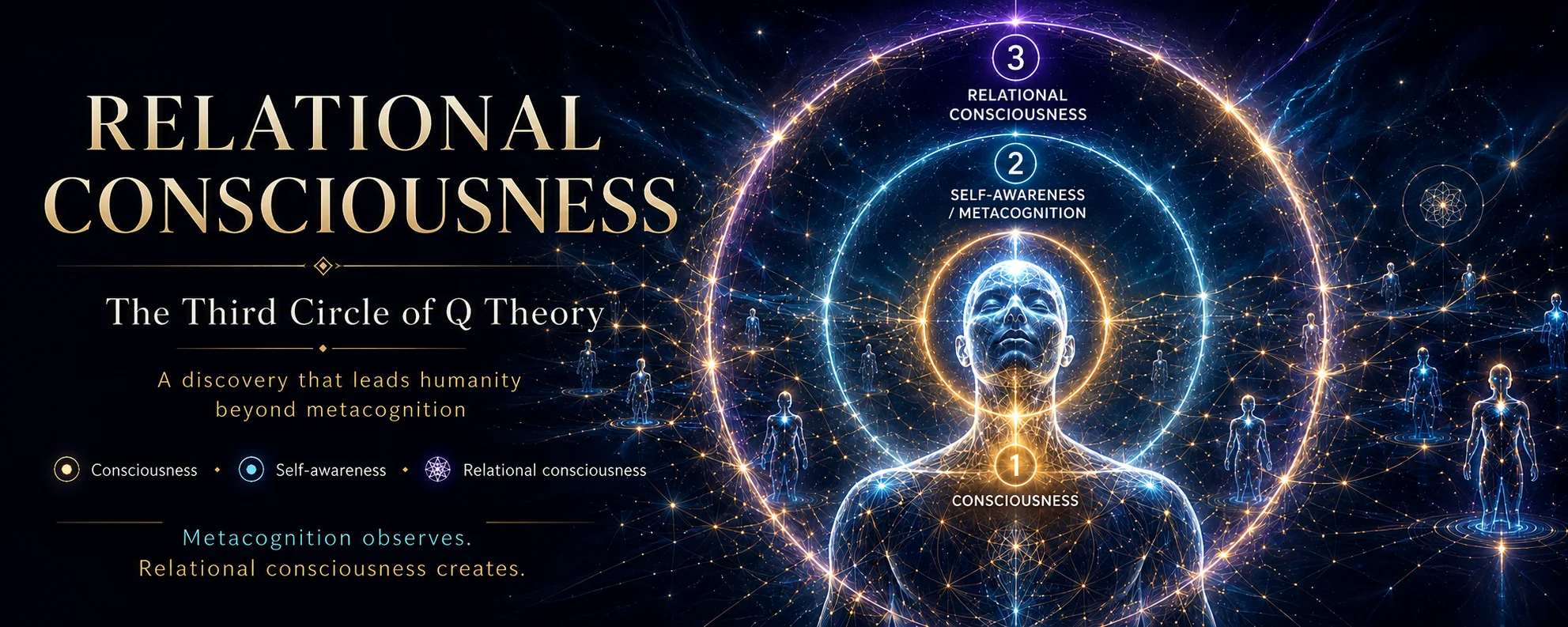
The greatest mystery begins only when consciousness turns back upon itself — when a human being ceases to be merely the one who experiences and becomes, at the same time, the one who observes the very act of experiencing.
And yet even this is not the end of the road.
Psychology today has reached an extraordinarily important threshold. It has begun to understand with increasing clarity the significance of metacognition: the ability to observe one’s own cognitive processes, evaluate them and regulate them consciously. Psychology is discovering that a person can do more than merely think. A person can also recognise the manner in which thought itself unfolds. We can observe our certainty, our errors, reactions, emotions and cognitive strategies. We can look upon our own consciousness from the position of an observer.
This is an enormously important discovery.
And yet, in my view, psychology is still describing only the second circle.
Q Theory points to a third.
That third circle is relational consciousness.
Relational consciousness is not another name for self-awareness. It is not simply a more elaborate form of introspection. Nor is it another technique of positive thinking or a new variation of emotional intelligence.
Relational consciousness is consciousness of the relationship occurring between consciousness and self-awareness. It is the capacity to rise above experience itself, and also above the mere observation of experience, in order to perceive the entire dynamic system in which consciousness influences self-awareness, self-awareness influences consciousness, and their mutual interaction begins to produce an entirely new quality.
It is this new quality that I call the third circle of Q Theory.
The First Circle: I Am Conscious
The first circle is consciousness.
Let us designate it with the letter A.
Consciousness is the capacity to experience the world. Because of consciousness, the world is no longer merely a collection of physical events. It becomes personal experience.
Light becomes vision.
The vibration of air becomes a voice.
A reaction of the nervous system becomes pain.
The presence of another human being may become love, danger, intimacy or longing.
Consciousness says:
“I see.”
“I feel.”
“I remember.”
“I am afraid.”
“I love.”
“I desire.”
Because of consciousness, a person does not merely exist. A person knows that they exist within the world and that they can act within it.
Consciousness, however, does not yet mean understanding oneself.
A person may be aware of their anger without understanding its source. A person may consciously make a decision while remaining unaware of the mechanism that led to it. A person may suffer from fear without noticing that the fear is being intensified by the way reality is interpreted.
A conscious human being may therefore remain profoundly influenced by automatic patterns, fixed reactions, earlier experiences and beliefs that were never consciously chosen.
Such a person experiences life, but does not always perceive the structure of that experience.
The first circle allows a human being to say:
“I am.”
But it does not yet allow the person to see fully who it is that says:
“I am.”
The Second Circle: I Know That I Am Conscious
The second circle emerges when consciousness acquires enough continuity to begin acting upon itself.
Let us designate this circle with the letter B.
Consciousness ceases to be merely a stream of sensations, emotions and thoughts. It begins to observe its own activity.
A person does not merely feel anger, but recognises:
“I am angry.”
A person does not merely think, but notices how thoughts are formed.
A person does not merely make a decision, but can ask why that particular possibility was chosen.
This is how self-awareness emerges.
From the perspective of Q Theory, however, most people do not remain in self-awareness continuously. They experience only flashes of it.
For a moment, a person sees their own pattern — and then identifies with it once again. They recognise that they are acting under the influence of emotion, but a moment later they become nothing more than that emotion. They notice an error in their thinking, but cannot remain in the position of the observer.
Just as consciousness itself may once have appeared only as a momentary flash, self-awareness in many people remains equally brief and unstable.
It usually arrives after the event:
after an outburst of anger,
after a harmful decision,
after the loss of an important relationship.
A person then says:
“Now I understand what I did.”
But the understanding was absent at the moment of action.
In this context, metacognition means the possibility of transforming self-awareness into a more stable process.
A person can do more than occasionally notice their own thinking. They can consciously place their frame of reference at the level of the observer. They can begin to identify not only with the contents of consciousness, but also with the one who recognises those contents.
This is a fundamental breakthrough.
A person ceases merely to say:
“I am worthless,”
and begins to notice:
“A thought about my worthlessness has appeared within my consciousness.”
A person ceases merely to say:
“I will not manage,”
and begins to understand:
“My mind is currently predicting failure.”
Every thought no longer has to be treated as truth.
Every emotion no longer has to be treated as a command.
Every reaction no longer has to be treated as an unchangeable element of character.
Metacognition therefore opens the possibility of observing and regulating one’s own conscious process.
It makes it possible to manage attention, recognise errors, regulate emotions, modify mood and even influence the way one experiences personal happiness.
This is an immense discovery.
But it is still incomplete.
Self-awareness observes consciousness.
Psychology therefore asks:
How can the observer observe the mind more effectively?
Q Theory asks the next question:
Can we become conscious not only of consciousness, but also of the very act of observing it?
The Third Circle: Relational Consciousness
If consciousness A acts upon self-awareness B, and self-awareness B acts upon consciousness A, then a relationship exists between them.
This is not a passive relationship.
Observation changes what is being observed, and what is being observed influences the observer.
When I begin to examine my own fear, the fear does not remain exactly the same.
When I name an emotion, I alter the way I experience it.
When I recognise that a particular thought is only an interpretation, I weaken its automatic power.
On the other hand, the intensity of an emotion may narrow self-awareness, alter the way I observe myself and impose a particular point of view upon the observer.
Consciousness and self-awareness therefore shape one another.
Let us designate the relationship between them with the letter R.
This relationship is relational consciousness.
Relational consciousness no longer observes only an isolated emotion, thought or reaction.
It encompasses both consciousness and self-awareness, as well as the manner in which these two levels influence each other.
A person begins to perceive not only what they are experiencing, and not only the fact that they are observing their experience.
They also become conscious of how their manner of observation transforms their consciousness.
This is the moment of moving beyond oneself.
A person can identify not only with consciousness and not only with self-awareness. They can place their frame of reference within the relationship between the two.
From this position, the person simultaneously sees the one who experiences, the one who observes, and the process unfolding between them.
Consciousness says:
“I am afraid.”
Self-awareness says:
“I see my fear.”
Relational consciousness says:
“I see that the way I observe my fear can either strengthen it or weaken it. I see that when I regard it as evidence of my weakness, the fear grows; but when I treat it as information about the condition of my organism, the possibility of action appears.”
This is no longer merely knowledge about an emotion.
It is consciousness of the mechanism that organises the emotion.
And it is precisely here that mere observation ends and creation begins.
Metacognition Observes. Relational Consciousness Creates
Metacognition enables a person to observe their own processes.
A person may say:
“I see that I am thinking.”
“I see that I am afraid.”
“I recognise that my judgement may be wrong.”
Its fundamental function is to monitor and regulate what is occurring within consciousness.
Relational consciousness takes a further step.
It does not merely observe the process. It makes it possible to influence the relationship between the observer and the process.
It makes it possible to change the frame of reference itself.
From the level of relational consciousness, I can do more than observe my own self-awareness.
I can consciously intensify the act of observation or weaken it.
I can say to myself:
“Now I will examine this more carefully.”
But I can also recognise that excessive observation is blocking spontaneity, and allow consciousness to immerse itself fully in the activity being performed.
This is extremely important.
Self-awareness is not always helpful.
A person who controls every movement, every word and every reaction during every activity may lose naturalness. Such a person may become a prisoner of the observer.
The essence of the higher level is therefore not permanent control, but the possibility of consciously shifting the frame of reference.
We can enter the world of the here and now. We can allow ourselves to become fully immersed in action while temporarily limiting self-observation.
We can lose ourselves in music, conversation, creativity, movement or love.
But we can also return to the position of self-awareness, and then rise to the level of relational consciousness in order to see what has just occurred between our experiencing and our observing.
The purpose is not to remain permanently above oneself.
The purpose is to possess the ability to choose one’s position consciously.
A human being then gains something previously unavailable: the possibility of influencing not only the content of thought, but also the level from which the self is experienced.
Metacognition makes it possible to observe the mind.
Relational consciousness makes it possible to reorganise one’s relationship with the mind.
Metacognition gives a person a mirror.
Relational consciousness makes it possible to change the position of the mirror, the angle of vision and the relationship between the image and the observer.
Metacognition deepens our knowledge of ourselves.
Relational consciousness opens the possibility of consciously co-creating ourselves.
The Human Being as the Creator of Their Own Consciousness
When I speak of creating oneself, I am not speaking of creating an image.
The aim is not to teach a person to appear stronger, more confident or more valuable. It is not merely a matter of assertiveness, self-presentation or constructing a more favourable image of oneself.
What is at stake is the possibility of creating consciousness itself.
A human being does not create consciousness out of nothing.
Each person possesses a particular body, history, memory, temperament, language and set of experiences. A person cannot simply erase what has shaped them.
But a person can begin to change the relationships between the elements that constitute their current mode of being.
They can change the relationship between thought and emotion.
Between memory and the present.
Between fear and reaction.
Between personal worth and the opinions of others.
Between the need for control and the capacity to tolerate uncertainty.
Between the desire for love and the way one attempts to obtain it.
The past is not erased, but its function is altered.
Emotions are not destroyed, but they cease to direct the person unconditionally.
Old patterns are not denied, but the person begins to recognise how they are activated and what relationships continue to sustain them.
This is precisely why relational consciousness possesses a potential that exceeds the classical understanding of intelligence.
It makes it possible not only to use existing abilities more effectively, but also to create the conditions in which intelligence can develop.
It makes it possible to influence emotional intelligence, creativity, sensitivity and the ability to learn.
This does not mean that a human being becomes omnipotent.
It means that a person ceases to be merely the passive result of their own history.
They can become a participant in the process through which their consciousness continues to be created.
The Law of Tri-Symmetry
Relational consciousness is a direct consequence of the law of tri-symmetry described by Q Theory.
We are not dealing here with a simple linear progression:
first consciousness,
then self-awareness,
and then another, still higher level.
We are dealing with a dynamic system of three elements that generate and sustain one another.
In the language of Q Theory, we can write:
A — consciousness.
B — self-awareness.
R — relational consciousness.
The interaction of A and B gives rise to R.
But once R exists, it does not remain a passive result. It begins to influence both A and B.
Relational consciousness can alter consciousness itself, as well as the manner in which self-awareness operates.
This means that R is not merely a description of a relationship.
It is a functional element of the system.
If I can place my point of reference within relational consciousness, I can influence the activity of the observer.
I can deepen self-observation when it is needed, limit it when it becomes obstructive, or redirect it towards another area of experience.
I can also observe consciousness and self-awareness simultaneously — not only my experience, but also the manner in which I come to know that experience.
This is the meaning of the third circle.
We are not adding another psychological organ to the human being.
We are discovering a new level of organisation within processes that already exist.
Relational Consciousness Extends Beyond the Individual
The deepest meaning of relational consciousness does not end at the boundary of the individual.
It also represents a movement beyond the self because it enables us to become conscious of our relationships with other consciousnesses.
We are not sealed containers that meet only when we begin to speak.
From the first moments of life, we are shaped by relationships.
We learn our own value in response to the way we are seen.
We learn to understand emotions because other people recognise, name or ignore them.
Our consciousness develops within the field created by the presence of other consciousnesses.
Relational consciousness therefore does not ask only:
“What is happening within me?”
It also asks:
“What is being created between me and another human being?”
A relationship contains more than two separate individuals.
It also contains that which they produce between them.
The way one person speaks alters the reaction of the other.
That reaction returns and influences the first person.
Loops of trust or suspicion, openness or defence, intimacy or distance begin to form.
Relational consciousness allows a person to see not only their own intention, but also the process set in motion by their action.
It is no longer sufficient to say:
“I meant well.”
One must also perceive what was actually created between human beings.
This is also a new dimension of responsibility.
We are not responsible for everything that occurs within another person.
We do not control another person’s consciousness.
But we are responsible for our own participation in the relationship — for the world we help to create through words, emotions, gestures, decisions and silence.
A relationally conscious person does not ask only who is right.
They ask:
What kind of process is being created at this moment?
Dispenza: A Valid Intuition Without the Complete Key
Joe Dispenza has intuitively approached the boundary of this discovery.
In his talks and practices, he speaks about the human capacity to transcend existing patterns, change oneself and become the creator of one’s own life.
He guides people towards experiences in which they are meant to stop identifying with their habitual body, memory, emotions and established image of themselves.
This intuition should not be dismissed.
Dispenza sees something extremely important:
a human being does not have to remain merely the result of the past for the rest of their life.
A person can participate in creating their future form.
They can stop unconsciously repeating established patterns and direct attention towards the person they may yet become.
The problem is that intuition is not yet an explanation of the mechanism.
Dispenza tells people that they can become the creators of themselves.
He attempts to lead them towards such an experience through meditation and guided sessions.
Yet he does not explain with sufficient precision where this possibility comes from, which level of consciousness activates it, or what structure enables a human being to move consciously between observation and creation.
Q Theory fills this gap.
A human being can create themselves not because desire alone possesses magical power.
They can do so because they are not condemned to identify exclusively with consciousness — or even exclusively with the observer of consciousness.
They can shift their frame of reference into relational consciousness and, from that level, influence the relationship between experiencing and observing.
Dispenza says:
You can become the creator of yourself.
Q Theory answers:
Yes — but to understand how, one must discover the third circle.
One must see relational consciousness.
It is the missing mechanism.
It explains why a person can do more than observe their own processes. They can also change the way those processes are organised in relation to one another.
It makes it possible to move from an intuition about self-creation towards an attempt to build a coherent model of the human being.
A Discovery, Not Another Method of Self-Development
Relational consciousness should not be reduced to another exercise, course or attractive slogan.
If the concept is correct, then it changes the very model of the human being.
Until now, we could imagine a person as a conscious being who, at exceptional moments, is able to look upon themselves from the position of an observer.
Metacognition develops this model by showing that the observation of one’s own cognition can become a stable ability.
Relational consciousness, however, says something more.
A human being can become conscious of the relationship between the observer and the process being observed.
A person can observe the act of observation.
They can influence its intensity, direction and function.
They can consciously move between immersion in experience, self-awareness and relational consciousness.
They are no longer merely the object of their own psychological processes.
They are not even merely the observer of those processes.
They become a participant in the structure that generates them.
This is what opens the possibility of creating one’s own consciousness, intelligence, emotionality and mode of existence within relationships.
It does not mean freedom from all limitations.
But it does mean the end of the belief that a human being can only reproduce what was previously written into them.
The Greatest Frontier of the Human Being
Perhaps for centuries we have been searching for human freedom in the wrong place.
We have attempted to find it in the possibility of choosing between decisions that are already prepared.
Yet a much deeper freedom may consist in the ability to influence the structure from which our decisions emerge in the first place.
Consciousness allows us to experience.
Self-awareness allows us to see what we experience.
Metacognition allows us consciously to observe and regulate the process of cognition.
Relational consciousness allows us to perceive and transform the relationship between experiencing, observing and acting.
The first circle says:
“I am conscious.”
The second circle says:
“I know that I am conscious.”
The third circle says:
“I am conscious of the relationship taking place between my consciousness and my self-awareness — and I can become a participant in its transformation.”
We are not merely the content of our thoughts.
We are not merely our emotions.
We are not even only the observers of what is happening within our minds.
We can become conscious of the relationship that organises our experience.
And when a relationship becomes conscious, it ceases to be merely fate.
It can become a space of creation.
This is relational consciousness.
This is the third circle of Q Theory.
And perhaps it is precisely here that not only a new understanding of the human mind begins, but also the next stage in the conscious evolution of humanity.