Article
Timoore Spaces
Four Languages for Describing the Same Reality and Their Mathematical Foundations
Author: Roman Grelewicz
#Timoore Spaces#Q Theory#Teoria Q#Piotr Tymochowicz#Roman Grelewicz#observer#relations#processes#mathematical formalism#graph theory#Qwadro#event-stream diagrams#circular diagrams
Prepared on the basis of Piotr Tymochowicz’s training sessions and his Q Theory
Abstract
This article presents the concept of “Timoore spaces” as an internal formalism of Q Theory for describing objects, processes, observation, interaction, and relations through several equivalent languages. The starting point is the existence equation for a system composed of at least two elements, together with the assumption that existence within a given descriptive space requires an observer or an observational relation. The same formal core is then presented in four visual forms: circular diagrams, relational diagrams based on the Qwadro principle, event-stream diagrams, and graph representations. The aim of the text is not to present an established mathematical or physical formalism, but to reconstruct the language of Q Theory as precisely as possible and to show how its elements are intended to connect psychological, relational, and physical descriptions within a single conceptual architecture.
Methodological note. The terms “Timoore space” and “Timoore algebra”, as well as the rules presented below, belong to the conceptual apparatus of Q Theory. References in this article to Hilbert and Banach spaces, Lie and Clifford algebras, quantum mechanics, or string theory are comparative and illustrative. They should not be understood as claims that the formalism of Q Theory is already part of standard mathematics or physics, or that it constitutes a proven derivation of those theories.
1. Why Create a New Space at All?
Mathematics is not merely the arithmetic of numbers. One of its greatest strengths is its ability to build formal worlds: sets of objects, operations, and relations governed by specified rules. Depending on the axioms adopted, we obtain structures with different capabilities. Groups, rings, fields, vector spaces, Hilbert spaces, and Banach spaces are not simply different names for the same thing. Each determines which objects may be considered, which operations are meaningful, and what may be inferred from them. In this sense mathematics “builds worlds” not through fantasy, but through precise conditions that define the admissible structure.
In Q Theory, the point of departure is the need for an even broader level of generalization. Instead of beginning with an extensive catalogue of axioms, it proposes a minimal structure that can be developed as the complexity of the system being described increases. The idea is dynamic: the simpler the object, the fewer assumptions are required; the more objects, relations, and levels of relations we introduce into the model, the richer the formal structure becomes. Within Q Theory, this way of thinking is called a Timoore space. Its central assumption is therefore not a particular geometric dimension, but the ability to extend the descriptive apparatus without losing a common core.
It is also essential that a single reality is meant to be described in several languages. Algebra serves as the overarching layer. Beneath it are four modes of visualization: the language of circular diagrams, the relational language associated with the Qwadro principle, the event-stream language, and the language of graphs. If the system is well constructed, each of these languages should preserve the same fundamental dependencies, even though each will make different aspects more visible. Circles show overlapping domains, streams emphasize process and time, Qwadro separates four modes of realization, and graphs are suited to tracking many connections at once.
2. The Observer as a Condition for Entering a Shared World
The most characteristic claim of the formalism discussed here concerns existence. In ordinary language, the question “does something exist?” seems trivial. In Q Theory, however, the answer depends not only on the object itself but also on how it is embedded in a network of observation. An object that is observed by nothing and enters into no relation with anything does not yet belong to the shared world of the given system. It may be treated as a concept, a possibility, or a process closed within itself. Only the appearance of an observer incorporates it into the structure.
It is worth noting immediately that the word “object” is shorthand here. In the narrative of Q Theory, objects should be understood primarily as processes that are sufficiently stable or sufficiently slow for us to treat them as things. This shift is important because it allows the same language to be applied to very different domains: particles, people, relations, psychological states, or social systems. The formalism is not meant to ask what “material” an element is made of, but rather what relations it enters into and whether its presence is witnessed.
This is easiest to see in a psychological example. A person may declare that they love a child, a friend, or a partner, but if the feeling is never expressed or communicated, then from the perspective of a shared relational space it remains confined to one mind. This does not mean that the private experience is “unreal” in the ordinary sense. Q Theory makes a stronger, technical distinction: what has no witness beyond its own carrier does not become an element of the shared relational space. Communication is therefore a process of creating observers—of multiplying the witnesses to what previously existed only privately.
Self-observation also appears at this point. If every process can in some sense be its own observer, a feedback loop arises. In the case of a human being, this leads to the concept of self-awareness: consciousness ceases to be merely a stream of experience and also becomes an object of observation. A person not only thinks but can notice that they are thinking; they not only feel but can observe their own feeling. In the Q formalism, this loop of self-reference is later represented by a squared term such as A².
3. The Existence Equation: From Two Objects to a System
Consider the simplest non-trivial system: two elements, A and B. For intuition we may call them Adam and Barbara, although they could equally well represent any two processes. We construct a system U that contains both elements. In its simplest form, we write:
U = A + B
The notation of a sum does not yet mean ordinary numerical addition. Here the “+” sign functions as a composition operator: it tells us that A and B are being considered as elements of a single system. The crucial step comes when the system U is treated as capable of acting on itself. Q Theory represents formal action by multiplication, so self-interaction is written as:
U · U = U²
Substituting U = A + B gives the expansion:
U² = (A + B)² = A² + B² + AB + BA
This equation is the central point of the construction. A² denotes the self-reference of element A—in a psychological reading, A’s insight into itself or self-observation. B² plays the analogous role for B. The term AB denotes the action of A on B, whereas BA denotes the action of B on A. In classical arithmetic with ordinary numbers, AB and BA are equal, but in a relational model there is no reason to identify the two directions of influence. Person A may affect B differently from the way B affects A; a field source may excite a receiver in a way that differs from the receiver’s response.
In an extended version, relation R may be added to the system as a separate element, followed by higher-order relations. The notation may then take the form U = A + B + R, while a multistructure may include A, B, relation R, and additional components R_A and R_B, describing A’s relation to the relation and B’s relation to the relation. At this point, simple circular diagrams begin to lose some information and a richer language becomes necessary.
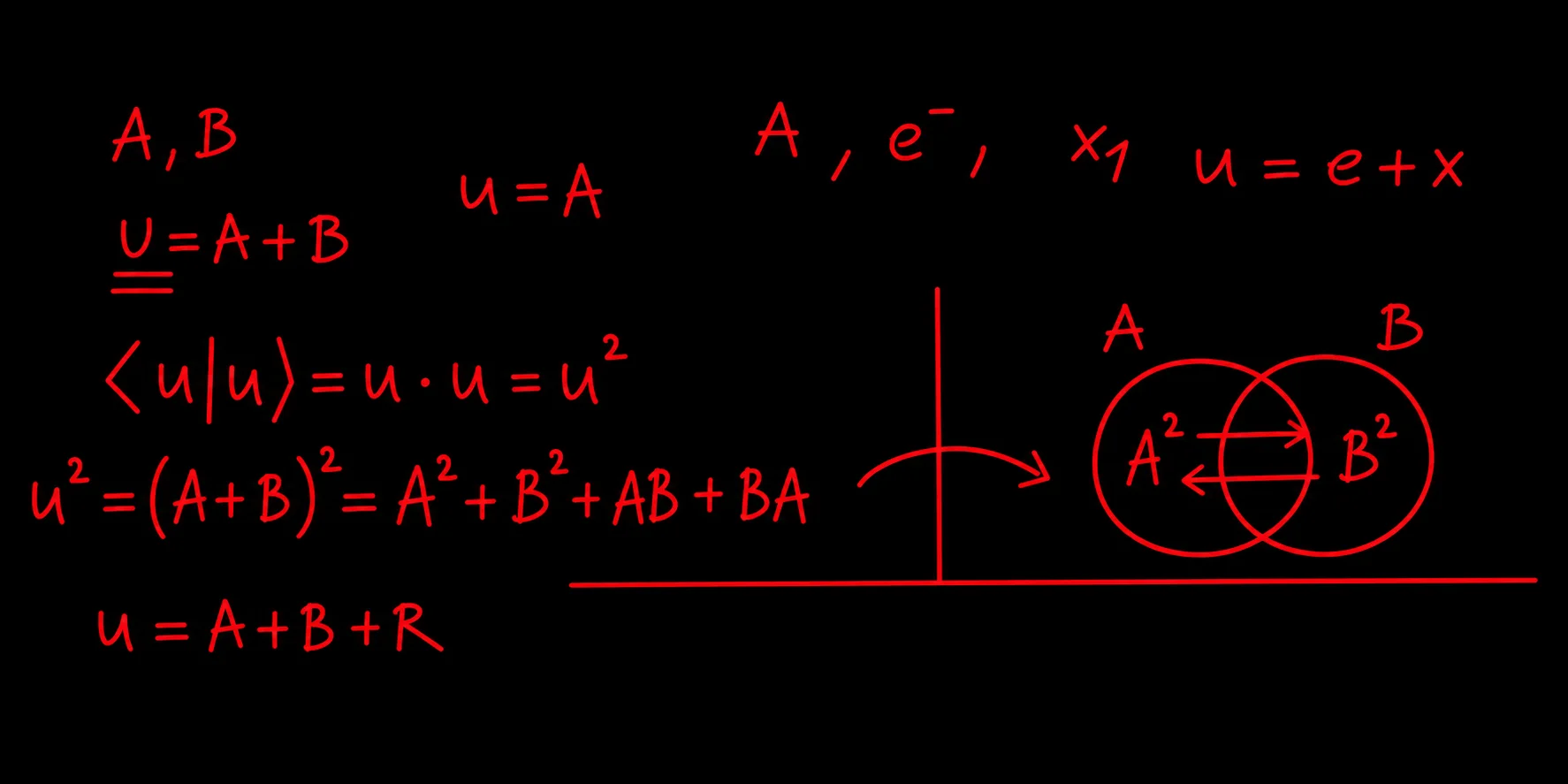
Fig. 1. Sketch of the derivation of the existence equation. On the left: U = A + B and the expansion U² = A² + B² + AB + BA; on the right: an attempt to translate the terms of the equation into overlapping regions A and B.
How to Read Figure 1
The upper part of the sketch shows the formal logic: two elements form the system U, after which the system is subjected to self-interaction. Expanding the square produces four types of terms. A² and B² are internal loops of self-reference, while AB and BA represent the two directions of transition between the elements. These four terms, rather than two, constitute the proper content of the system once the relation is activated.
On the right, two overlapping regions can be seen. The non-shared part of A may be treated as the domain of A², the non-shared part of B as the domain of B², while the common region is where interaction becomes manifest. The arrows remind us, however, that geometric overlap alone is not sufficient: AB and BA may differ, so directionality must be preserved. The figure therefore acts as a bridge between algebraic notation and the language of diagrams.
4. First Language: Circular Diagrams
The circular diagram is the most intuitive language of Q Theory. A single concept can be represented by one circle. When a second element appears and the two begin to interact, the circles overlap. If a stable relation develops, another region representing R must be added to the picture. In simple cases this is clear: the reader can immediately see what is separate, what is shared, and where a third component appears.
The difficulty begins with multistructures. Suppose Adam and Barbara are not only in relation R, but each also develops a relation to that relation: R_A and R_B. Adam may, for example, experience not only the relation with Barbara itself, but also his own state of being in love; Barbara may likewise relate to her own experience of that relation. We then have five elements: A, B, R, R_A, and R_B. A circular diagram can show their regions, but it becomes increasingly difficult to represent every possible interaction among them.
The interaction between R_A and R_B is particularly important: the way Adam experiences his love may influence the way Barbara experiences hers, and vice versa. Such dependencies are not always visible in a simple arrangement of overlapping circles. Circular diagrams are therefore useful for introducing the theory and for simple structures, but as the number of levels increases, one must either produce several drawings or move to another language.
5. Second Language: Relational Diagrams and the Qwadro Principle
The second language is a relational notation based on the Qwadro principle. Its purpose is to separate four ways in which a process can manifest itself. In the training-session notation, four positions are arranged around a central system: image, relation, actual event, and probability. A concept that has not yet entered into a full relation may be represented by a single active region—for example, a cloud of possibilities. When it encounters another process and is observed, however, the configuration expands into four fields.
In everyday language, this can be understood as follows. A person whom nobody knows exists for the shared system primarily as a possibility. When that person meets someone else, an image of them appears in the other person’s mind, real events take place, a relation is formed, and the realm of possibility does not disappear—it remains as what could still happen. Full existence in this language therefore does not consist in replacing one category with another, but in activating all four dimensions of description.
In the physical analogy from the transcript, two processes initially described as probability clouds, once they meet, acquire the possibility of realization in other aspects: as an observable manifestation, as an event, as a relation, or as a source of further interactions. It must be remembered, however, that this is the language of the Q model, not the standard notation of quantum mechanics. Its function is to show how a single concept can be “unfolded” into four kinds of presence.
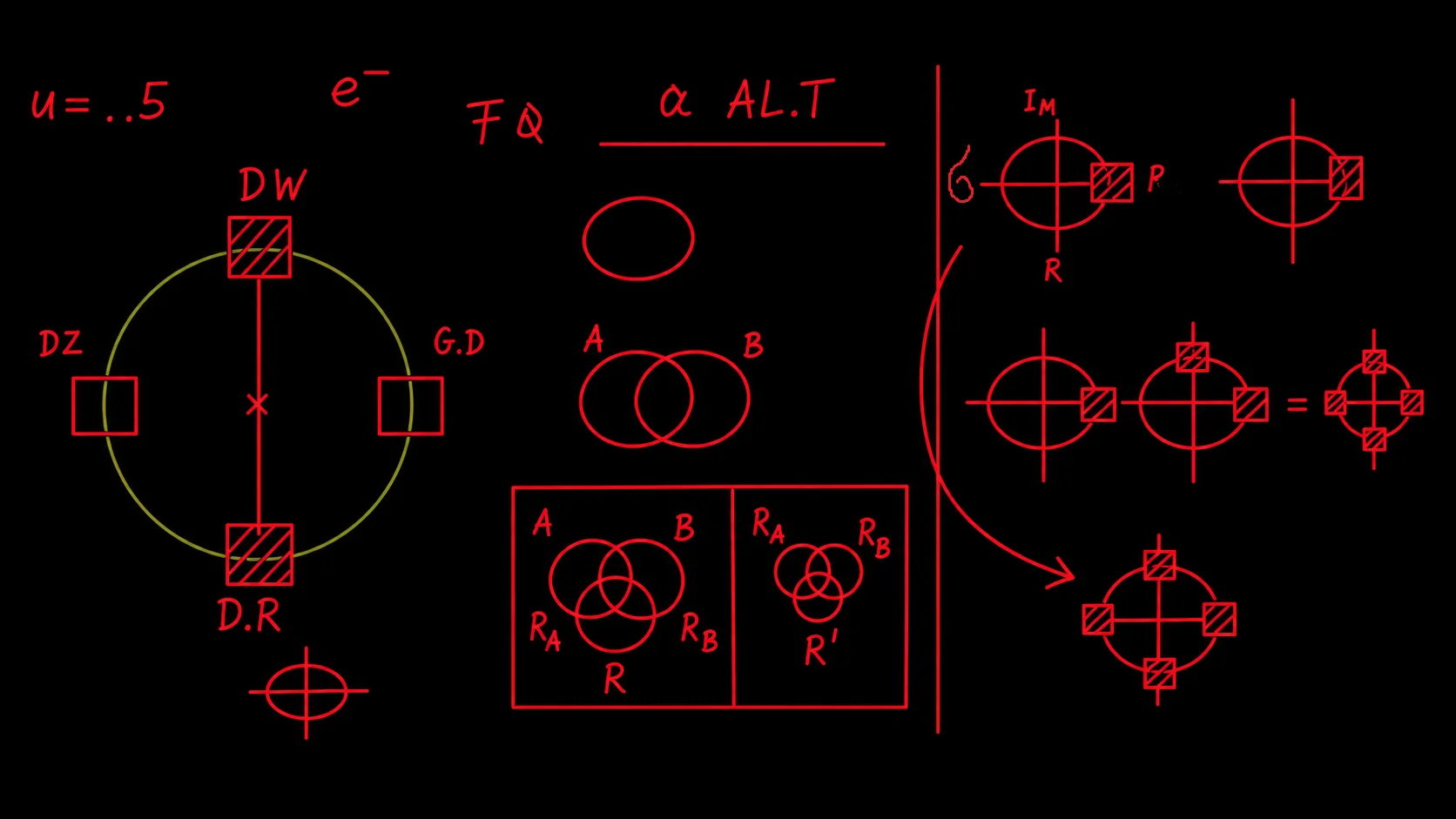
Fig. 2. Sketch of the relational language based on the Qwadro principle. On the left is a scheme of four positions around a center; in the middle, the transition from a simple concept to an A–B–R configuration; on the right, examples of activating successive fields.
How to Read Figure 2
The left-hand scheme is the most important: the central process is surrounded by four positions corresponding to four modes of realization. In the training notes, the fields are marked with abbreviations; the formal meaning, however, does not depend on the specific shape of the square. The point is that one process can be considered simultaneously as an image, an event, a relation, and a possibility.
The central sketches show the transition from a simple system of two overlapping elements, A and B, to a structure in which relation R and relations to that relation begin to generate additional regions. The right-hand part of the figure shows operationally how the activation of a single field can be expanded into a complete four-field configuration. This is the graphical equivalent of the idea that observation and interaction do not merely “add” a second object, but activate an entire set of new possible modes of existence.
6. Third Language: Event-Stream Diagrams
The third language is the most dynamic. Instead of drawing objects as static circles, it represents them as pulsating loops and streams. A loop denotes a process with its own rhythm. In this view, time is not an external ruler applied to the object, but emerges as a consequence of repetition and the frequency of the process. Wherever something occurs cyclically, we can speak of rate, phase, and sequence.
The interaction of two processes is then the meeting of two streams. Each has a spatial and a temporal component, and when they meet a new intermediate loop is formed. A relation is therefore not a static bridge between already completed things, but a process with its own dynamics. This is a major shift in intuition: a relation can begin to exist as a third process and, as a consequence, can itself enter into relations with other processes.
In the source narrative, this language is then used to construct analogies with elementary particles. A short-lived loop that appears and disappears is treated as an image of a virtual process, while a stable structure is said to arise when two processes observe one another and maintain frequency compatibility. Resonance becomes a condition of stability. Further interweavings of several loops are used to depict more complex structures, while individual links between them symbolize carriers of interaction.
Important scientific distinction. In Q Theory, the stream diagrams are a language of analogy and modeling. Visual similarity to strings, branes, quarks, or gluons is not in itself evidence of equivalence with string theory or with the Standard Model of particle physics.
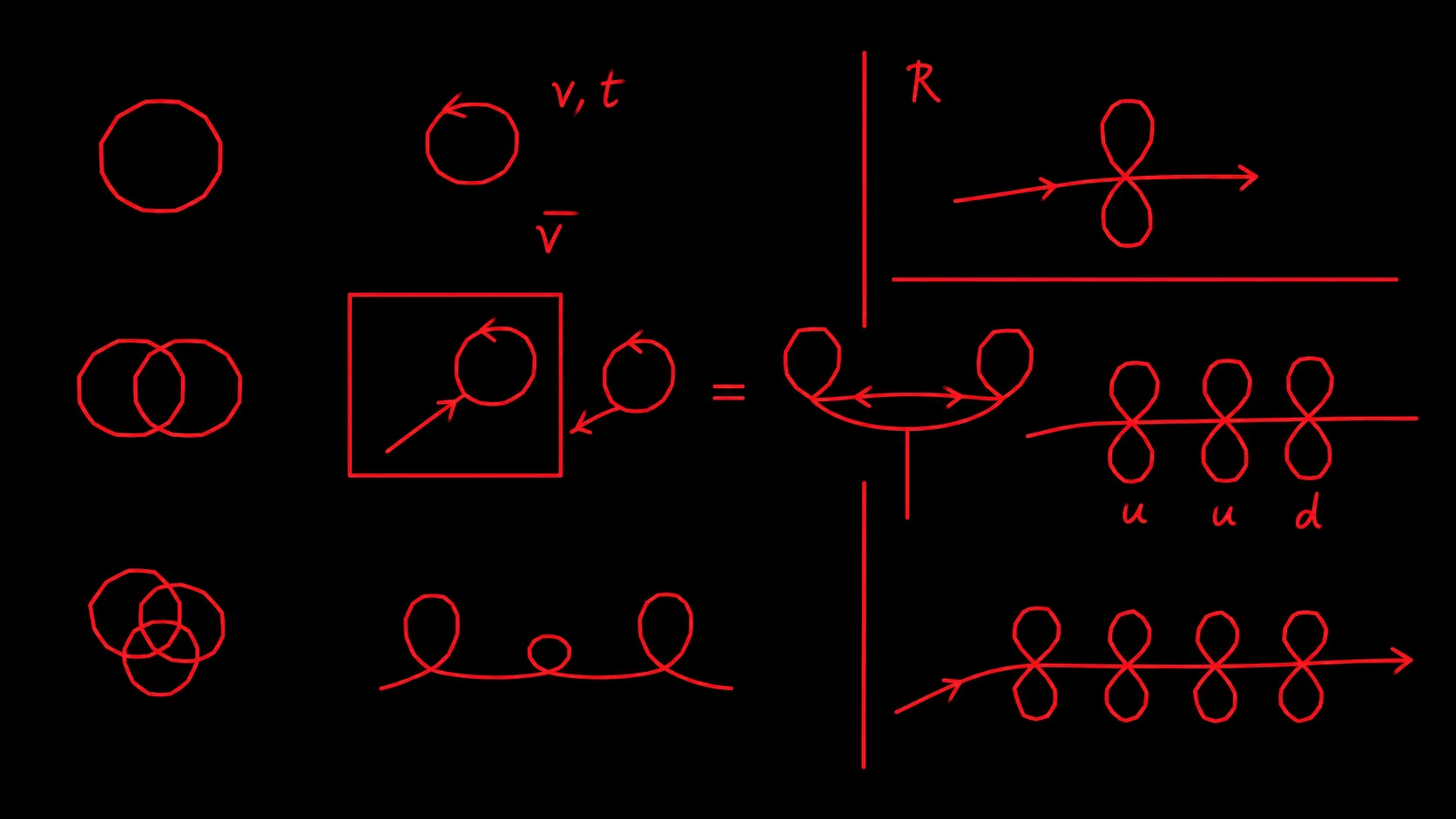
Fig. 3. Sketches of the event-stream language. On the left, the transition from a concept and simple interactions to loops can be seen; on the right, loops are treated as processes running along an axis, and their interweavings are used to model complex structures.
How to Read Figure 3
The upper-left circle represents the simplest concept. The subsequent sketches show that once observation or interaction is introduced, feedback loops and intermediate structures appear. The lower central line, with a small loop between larger ends, is an intuitive image of a relation as a process rather than as a static connection.
The right-hand side develops the language along an axis. A single loop may represent an elementary process; a set of repeating loops—a composite structure. The symbols u, u, d beneath three loops refer to the quark description of the proton, while the lower sketch with intermediate loops points to carriers of interaction between the components. In this article, this section should be read not as a finished theory of particles, but as a demonstration of what the language can express: increasingly complex models can be built from a simple alphabet of loops and interweavings.
7. Fourth Language: Graph Representations
The fourth language draws on the intuition of graph theory. Objects become nodes, interactions become edges, and self-reference can be drawn as a loop returning to the same node. This language is particularly useful when the number of relations grows. Instead of trying to fit every dependency into the geometry of overlapping circles, we can simply add further nodes and edges.
Q Theory modifies ordinary graph intuition by treating relation R as a full-fledged node. In a conventional graph, a relation between A and B would usually be represented simply as an edge. Here, the relation can itself become an object of further interactions, so it receives its own node—usually drawn as an empty point placed between A and B. This makes it possible to represent not only the bidirectional A–B relation, but also bidirectional A–R, B–R, and R–R relations. In this way, the relation acquires its own formal identity.
For a simple A–B–R system, a triangle can be drawn: A and B occupy two vertices, R the third, and the lines show possible communications. If A and B can still interact directly, we add the edge A–B. If each element can react with itself, self-loops are added. Such a picture is already far more informative than a single set of overlapping circles.
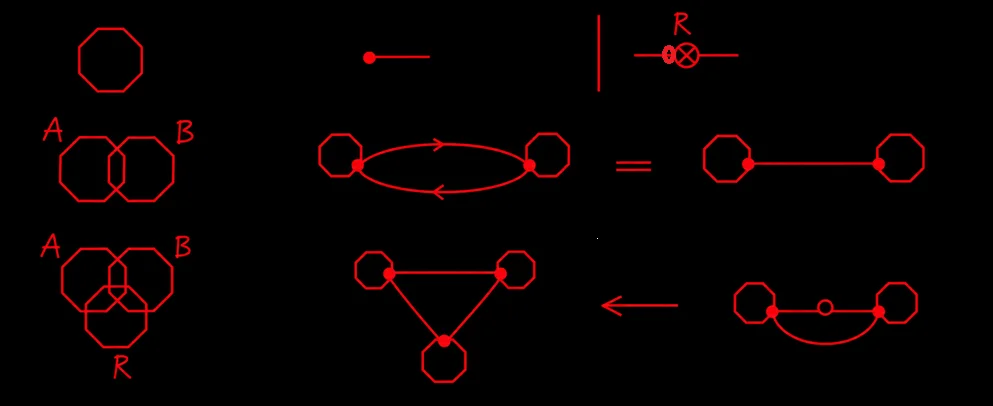
Fig. 4. Transition from simple circular diagrams to graph notation. The interaction of two objects can be reduced to a single bidirectional edge, while relation R is introduced as a third, separate node.
How to Read Figure 4
On the left, the circular language is retained: a single concept, two overlapping elements A and B, and the A–B–R system. The upper middle part shows the simplification of two arrows, A→B and B→A, into a single undirected line if mutual interaction in both directions is assumed from the outset. This is purely a notational device—it reduces the number of arrows without removing reciprocity.
The lower triangle is crucial. Relation R is no longer left as an invisible property of the A–B edge, but is drawn as the third point of the system. This allows us to ask separately about the influence of A on R, R on A, B on R, R on B, and the direct A–B interaction. It is this shift that makes the graph language convenient for higher-order relations.
8. Multistructures and the Advantage of Graphs When Relations Multiply
The most convincing argument for graphs appears in multistructures. Consider five elements: A, B, the relation R between them, and two relational states R_A and R_B. In a circular diagram, each can be shown as a region, but the number of possible contacts grows rapidly. Moreover, some connections are difficult to display without superimposing additional drawings.
In a graph, it is enough to place five nodes around a circle and draw the edges corresponding to all admissible interactions. We can then directly indicate the connections R_A–R_B, A–R_B, B–R_A, A–R, B–R, and A–B. If the structure is maximally dense, the result is a complete graph on five nodes. In a circular geometric arrangement, its diagonals form a characteristic five-pointed star.
The star is not a mystical symbol here. It is simply a consequence of the geometry of a complete five-node graph drawn on a circle. It nevertheless has cognitive value: at a glance it shows that every element can potentially remain in a direct relation with every other element. This is why the graph becomes the most scalable language. Adding new relations does not require rebuilding the entire metaphor; we simply add nodes and edges.
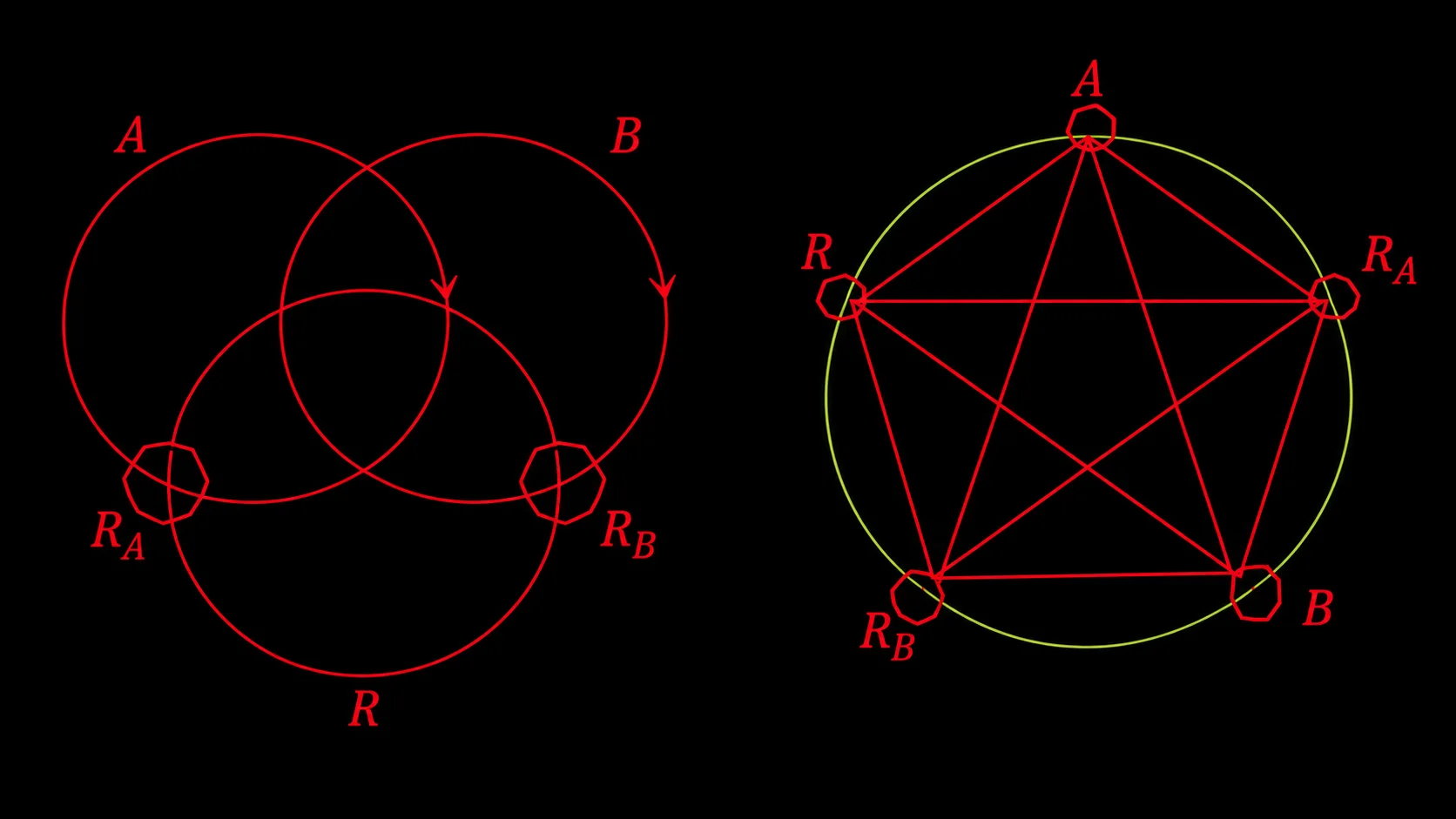
Fig. 5. A multistructure in two languages. On the left: overlapping regions A, B, and R with the additional relations R_A and R_B; on the right: a circular five-node graph in which the full set of connections forms a pentagon and a star.
How to Read Figure 5
The left-hand side shows the limitation of the circular diagram. The basic regions A, B, and R are visible, with relations R_A and R_B at the edges, but not every possible direction of influence is unambiguous. The positions of the regions alone do not immediately tell us whether R_A interacts with R_B, whether A directly influences R_B, or whether B interacts with R_A.
The right-hand side removes this ambiguity. Every element is a node, and every possible relation has its own line. If the five nodes are connected pairwise, we obtain a complete network of dependencies. This notation does not merely “beautify” the structure; it organizes information: the reader can count connections, trace paths of influence, identify feedback loops, and add further levels without having to create several separate drawings.
9. One Formalism, Four Visualizations
The central idea of Timoore spaces is not that one of the presented languages is true while the others are merely decorative. Their roles are complementary. Algebra is intended to preserve the structure in its most compact form. Circular diagrams build intuition about regions and overlap. Qwadro separates four qualities of description. Stream diagrams emphasize dynamics, time, and resonance. Graphs reveal the network of all possible relations.
This can be compared with cartography. The same Earth can be represented on political, physical, road, and geological maps. None of these maps is the Earth itself, yet each brings out a different kind of information. Similarly, in Q Theory the same A–B–R structure can be expressed as circles, loops, Qwadro fields, or a graph. The condition of consistency is that changing the language must not alter the basic architecture of the relations.
For a scientific reader, the key question is therefore not “which picture is the most attractive?” but “is there a well-defined mapping between the representations?” If the algebraic components A², B², AB, and BA have unambiguous counterparts in the circular, stream, and graph representations, then we can speak of a common core of the model. If, however, one visualization loses relations, it must be supplemented or replaced with a richer language. This is precisely why graphs appear at the end as the most economical tool for complex multistructures.
10. What Does This Formalism Contribute to the Description of the Psyche?
The most interesting feature of Q Theory is its attempt to use the same apparatus to describe physical and psychological processes. This does not mean that the psyche is reduced to particles, or that an interpersonal relation is literally a physical field. The point concerns structural level: in both cases we can ask about elements, observers, interactions, feedback loops, and relations that arise as new processes.
The example of love is especially clear. A may love B, but as long as B has no signal that such a relation exists, the shared A–B space does not yet contain an observable relation of love. When communication appears, B becomes a witness to A’s state and relation R gains its own presence. A may then begin to experience the very fact of loving—R_A arises. B may experience their own relation to love—R_B arises. At that point, we no longer have a simple pair of people, but a network of psychological processes that modify one another.
Friendship, conflict, trust, authority, or community can be described in the same way. A relation is not merely an addition to the people involved; it is a process that can affect each of them. Moreover, a person can remain in relation not only with another person, but also with their own representation of the relation. Such a model helps explain why two people may formally take part in the same situation yet psychologically inhabit two different structures.
11. The Boundary Between a Model and a Scientific Theory
If the article is also to be read by scientists, three levels must be clearly separated. The first is the conceptual level: Q Theory proposes a vocabulary of objects, observations, and relations. The second is the formal level: symbols, operations, equations, and rules for moving between representations appear. The third is the empirical level: it is necessary to define how quantities are to be measured, what predictions the model generates, and what experiment could falsify it.
The transcript on which this text is based develops mainly the first two levels. It presents a language and a formal intuition. It does not yet provide a complete system of axioms in the sense expected of a mathematical publication, nor an empirical procedure capable of testing all of the physical analogies. An intellectually honest scientific presentation should therefore speak of a program of formalization rather than of a closed theory confirmed by experiment.
This does not diminish the value of the exercise itself. On the contrary, a precise separation of hypothesis, model, and result is a condition of serious discussion. If Timoore spaces are to become a research tool, the next step should be to formulate a minimal set of definitions, specify the types of objects and operators, establish rules of equivalence between the four languages, and define the conditions under which axiomatic extension is permitted.
12. Prospects for Further Development
The most promising feature of this construction is its modularity. A simple case can be represented by two elements and the four terms of the existence equation. As relations are added, the structure grows, but the basic alphabet does not have to change. This makes it possible to build a hierarchy: from a concept, through interaction, relation, and multistructure, all the way to very large networks.
For psychological applications, it would be particularly interesting to investigate whether graphs of relations can be used to map real networks of influence in groups, families, or communities. For the mathematical layer, the key task would be to clarify the algebraic meaning of the “+” operator, multiplication understood as action, and squares interpreted as self-reference. For the philosophical layer, the remaining question is whether observability should be a condition of ontological existence, or merely a condition of existence within a given model and a shared space of experience.
This last distinction is fundamental. If the statement “without an observer it does not exist” is ontological, it becomes a very strong claim about reality. If, however, it is understood operationally—“without an observer it does not enter the system being described”—the position becomes much more cautious and much easier to formalize. It is precisely such clarifications that determine whether an intuitive concept can be transformed into a tool suitable for scientific analysis.
Conclusion
Timoore spaces are an attempt to build a single meta-language for structures that, at first glance, belong to entirely different domains. The starting point is simple: there is an element A, there is an element B, and observation, interaction, and relation appear. From this minimum arise the system U, its self-reference U², and four basic terms: A², B², AB, and BA. The structure can then grow further—by adding relation R, relations to relations, additional processes, and further levels of observation.
The strength of the concept lies in its use of multiple languages. The same structure can be viewed as overlapping regions, as the four fields of Qwadro, as an interweaving of pulsating streams, or as a graph network. Every representation reveals something and conceals something. For this reason, the most mature use of the formalism does not consist in attachment to a single picture, but in the ability to move between languages and test whether they preserve the same structure.
For a general reader, this can be a story about a very practical principle: relational reality begins where a witness, communication, and feedback appear. For a technical reader, it is a proposal for a program of formalization that still requires strict definitions and tests. In both cases, the most interesting idea remains the same: an object is not an island. Its significance emerges only within a network of interactions, and a relation can become a new object that begins to develop its own dynamics.
Author: Roman Grelewicz
Prepared on the basis of Piotr Tymochowicz’s training sessions and his Q Theory.
Source material: “Transcript – Timoore Spaces”.