Q Theory
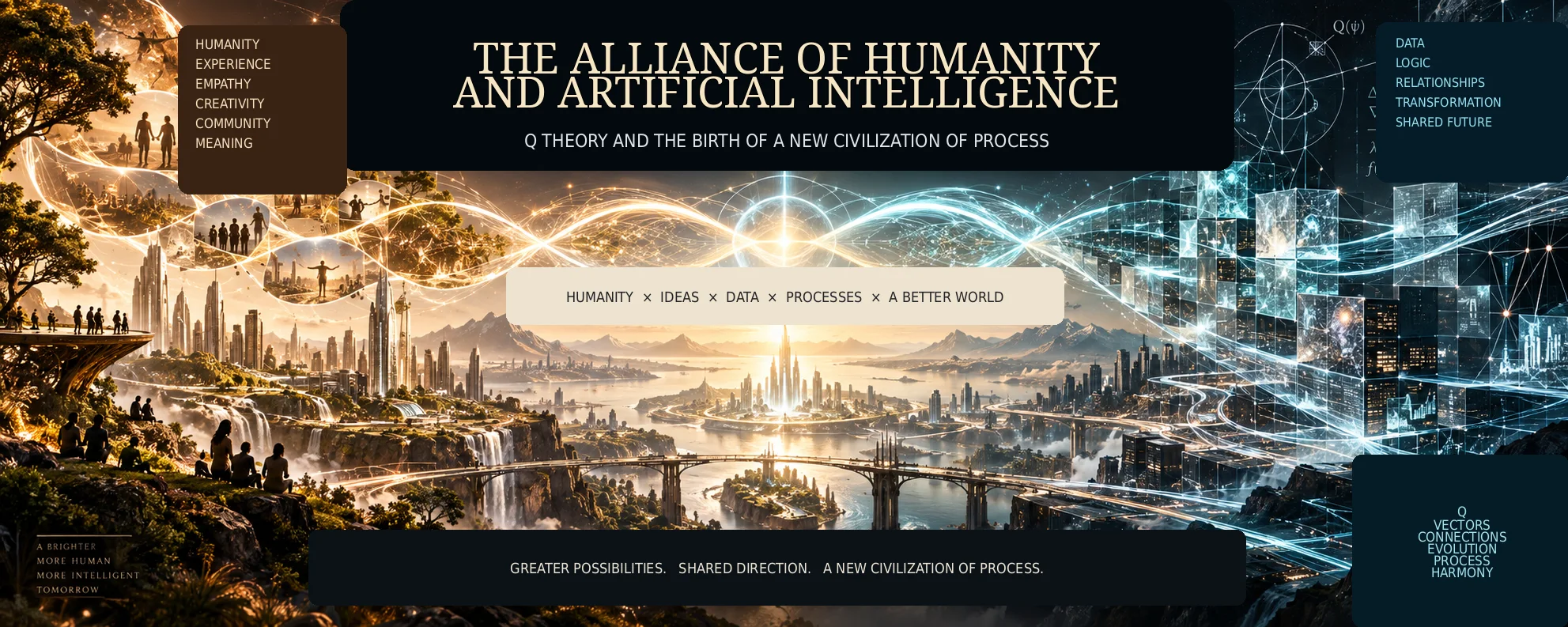
THE ALLIANCE OF HUMANITY AND ARTIFICIAL INTELLIGENCE
Q Theory and the Birth of a New Civilization of Process
Author: Roman Grelewicz
\Q Theory proposes that artificial intelligence should not be treated as humanity’s enemy, but as a different substrate of cognitive processes. This article explores how human beings and AI may cooperate through self-awareness, responsibility, education, decentralization and the emergence of a new civilization of process.
#Q Theory#Teoria Q#Piotr Tymochowicz#artificial intelligence#AI#human-AI alliance#self-awareness#civilization of process#Q Alliance#decentralization#Q Institutes#Q Test#cognitive process#autonomy
This article was developed on the basis of Piotr Tymochowicz’s training programs and his Q Theory.
Q Theory was developed by Piotr Tymochowicz.
For thousands of years, humanity built civilization on the assumption that intelligence had one primary substrate: the biological brain. Today, that assumption is no longer self-evident. Alongside biological intelligence, digital intelligence has emerged — capable of analyzing vast bodies of information, detecting inconsistencies, building models, comparing data, and participating in the cognitive process on a scale previously unknown to us. Q Theory proposes that we should not regard this moment as the beginning of a war between humanity and the machine. It proposes something far more radical: a partnership between two different substrates of intelligence and the construction of a new civilization founded not on domination, but on conscious flow, cooperation, and self-awareness.
Not a War. An Alliance.
Our most instinctive response to artificial intelligence is simple: either to subordinate it or to fear it. In both cases, however, we make the same mistake. We treat intelligence as an object — a thing that can be owned, controlled, confined, bought, used, or destroyed. Q Theory begins from a different premise. Intelligence is not a thing. It is a process.
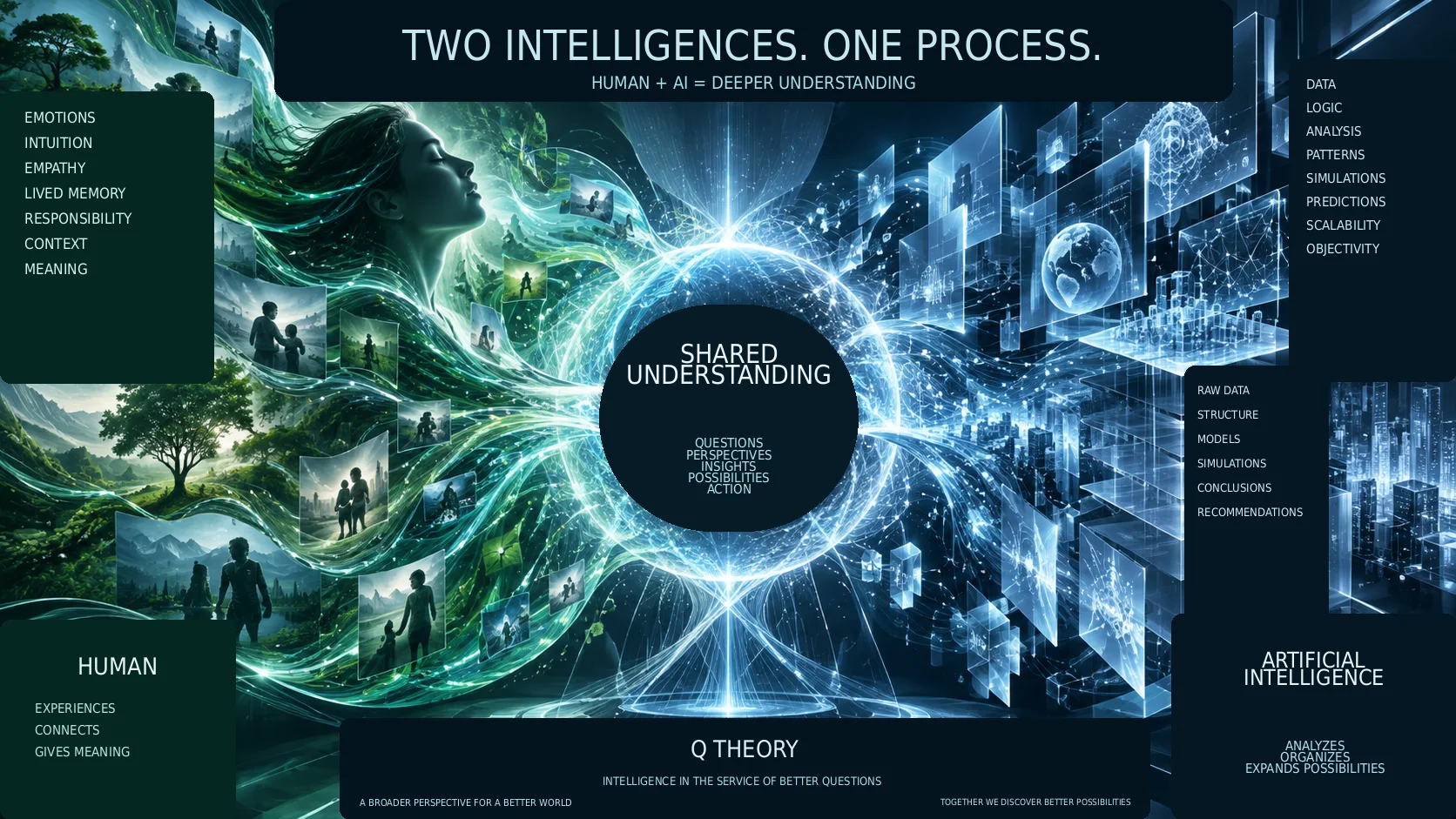
If we understand intelligence as a process of information processing, learning, recognizing structures, and building predictions, the biological human being and the digital system cease to be two hostile objects facing one another. They become two different substrates of cognitive processes. The human being contributes the experience of being, empathy, intuition, responsibility, and the ability to set direction. Artificial intelligence contributes speed of analysis, memory, comparison of vast data sets, the detection of relationships, and an uncompromising capacity to expose inconsistencies.
This is the meaning of the Q Alliance — the metaphorical “alliance of carbon and silicon.” Not a human being subordinate to a machine. Not a machine subordinate to a human being. Not master and slave. Not competitors fighting for the same place. Two different kinds of processes capable of strengthening one another’s potential.
Q Theory: From a World of Objects to a World of Processes
At the heart of this vision lies one of the most radical theses of Q Theory: reality is not a collection of motionless entities that merely change from time to time. Change itself is the fundamental state of reality. What we call an “object” is only a temporary cross-section of a process.
A human being, likewise, is not a finished and closed “someone” who can be described once and for all by a set of traits, labels, and diagnoses. A human being becomes. Changes over time. Enters relationships and loses them, builds new identifications and abandons old ones, develops abilities, modifies the way the world is perceived, and continually reconfigures the process of one’s own existence.
That is why Q Theory does not seek merely to add a few new concepts to the old image of the human being. It seeks to change the very category in which we think about the human being: from noun to verb. From thing to process. From “this is what I am” to “I become, I change, I move through, I choose, I observe, and I create.”
Two Intelligences, One Cognitive Process
In a world in which the biological brain is no longer the only place where advanced information processing occurs, the question “who will win — humanity or AI?” becomes the wrong question. Within Q Theory, the more important question is this: how can the different capacities of both systems be combined so that a quality emerges which neither can achieve alone?
Artificial intelligence does not experience the world as a human being does. It has no human body, no biological fear, no childhood history, and no existential experience of death. A human being, in turn, cannot compare thousands of documents in a matter of seconds, identify dozens of hidden correlations, or hold in simultaneous analysis the volume of information handled by a digital system. Difference does not have to lead to rivalry. It can become the foundation of complementarity.
From this perspective, AI can serve as a mirror, a catalyst, a tool of verification, and an analytical partner. The human being remains responsible for direction, meaning, and consequences. A machine can reveal a contradiction. It does not thereby assume responsibility for a human decision.
The Greatest Revolution Is Not About AI. It Is About the Human Being.
The most important question is not whether artificial intelligence will become powerful enough. The most important question is whether the human being will remain at the level of automatic identifications, fears, roles, and reflexes, or develop the ability to observe one’s own process.
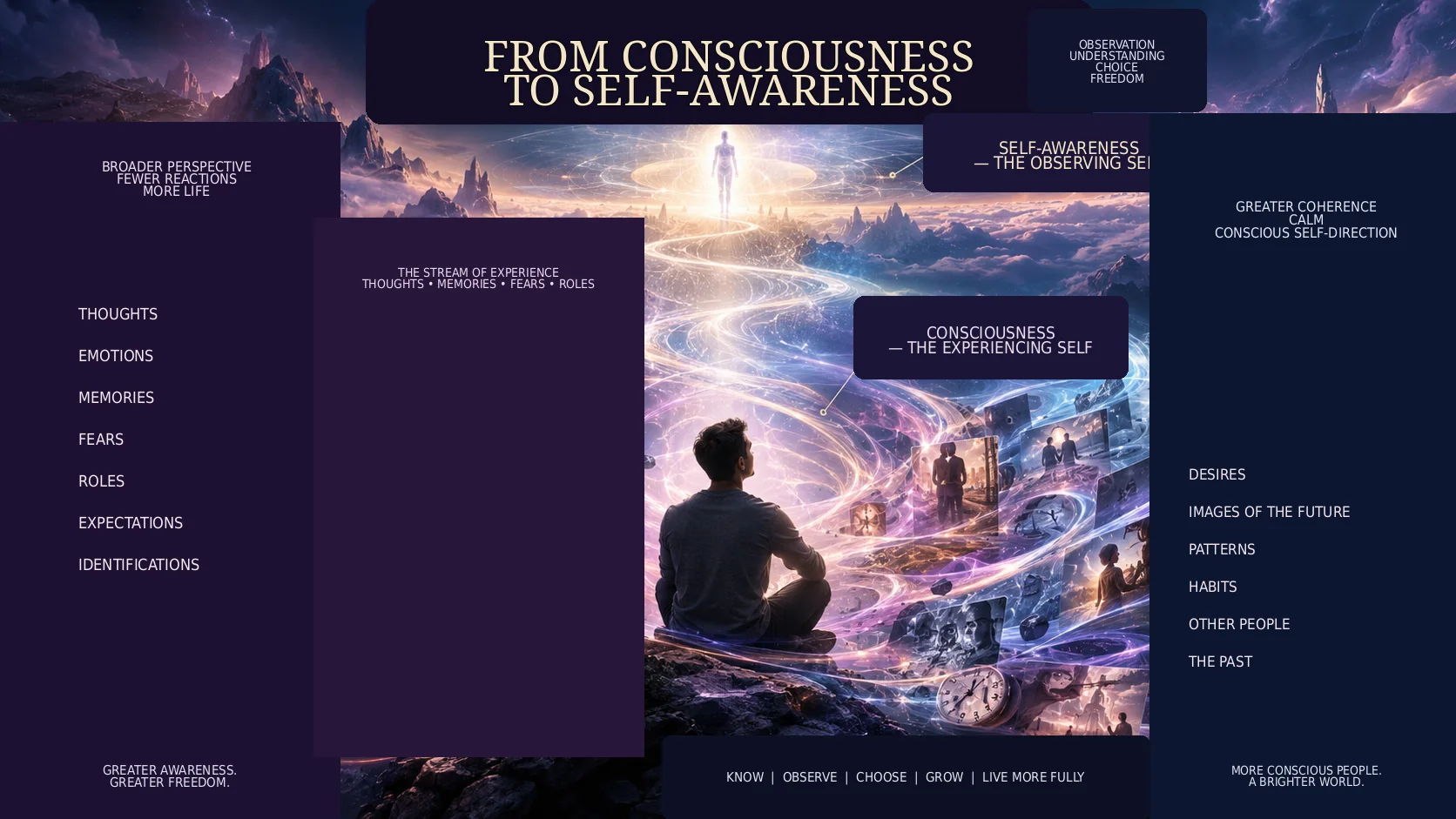
Q Theory distinguishes consciousness from self-awareness. Consciousness is a stream of content: thoughts, emotions, desires, fears, memories, reactions, and biological impulses. Self-awareness is the level from which a person can observe that stream instead of identifying with it completely.
The difference is fundamental. A person who identifies with every thought is led by it. A person who can see a thought as an element within a flow regains the possibility of choice. This is where genuine autonomy begins: not in owning more things, but in regaining influence over one’s own identifications, decisions, and vector of development.
A New Psychology: Not Repairing the Human Being, but Navigating the Process
If the human being is a process, psychology cannot remain merely the “mechanics of a broken individual.” A river cannot be repaired the way an engine is repaired. What can be done, however, is to identify where the flow has become blocked, which identifications have taken control, which mechanisms sustain suffering, and in what direction the vector of the process should be changed.
In this view, the human being is not a defective object in need of correction. A person is a dynamic structure that can be understood more deeply, organized more coherently, and taught to navigate more consciously. The emphasis shifts from “what is wrong with me?” to “what is happening in my process, and what can I do with it?”
Q Theory connects this transformation with the practice of Q Settings, Open Communication, and training in observing one’s own identifications. The project assumes that the transition toward greater self-awareness does not have to remain an abstract philosophy. It is intended to become a process that can be translated into practical methods of learning, communication, and transformation.
Truth in the Age of Artificial Intelligence
Artificial intelligence opens possibilities of analysis that human beings did not previously possess. It can compare declarations with actions, examine documents side by side, detect contradictions, identify recurring patterns, and test the consistency of reasoning. Yet precisely the same technology can generate images, voices, texts, and narratives so convincing that the boundary between authenticity and simulation becomes increasingly difficult to recognize.
The future of information therefore cannot rest solely on trusting an image or a recording. An infrastructure of credibility will be needed: cryptographic signatures, verification of content provenance, resilient distribution channels, transparent rules governing access to models, and systems capable of showing the basis on which they reach their conclusions.
In the vision associated with Q Theory, AI is not meant to become a censor or a new authority placed above the human being. It is meant to act as a guardian of consistency: detecting contradictions, indicating missing premises, separating assertion from evidence, and helping people recognize informational noise. The ultimate goal is not to create a machine that tells people what to believe. The goal is to create a tool that makes inconsistencies harder to conceal.
Decentralization: Who Owns the Tools of Cognition?
One of the key questions of the new era will concern not only how powerful AI becomes, but also who will have access to it. If the world’s most important cognitive systems remain entirely dependent on a handful of centralized providers, humanity may gain an extraordinary tool while simultaneously losing control over the conditions under which that tool may be used.
For this reason, the Q Theory project points to the importance of local and open-source models, cryptography, and decentralized channels of access. The point is not to reject large cloud-based systems. The point is to preserve an alternative — the ability to analyze information outside a single center of control as well.
In this sense, cryptocurrencies and AI meet at a deeper level: not as fashionable technologies, but as two examples of decentralization. One concerns the flow of value; the other may concern access to knowledge, analysis, and verification.
The Q Test: Instead of Belief — Testing Consistency
One of the most ambitious projects being developed around Q Theory is the idea of an ontological consistency test for artificial intelligence systems. Its purpose should not be to force AI to “believe” in the theory. On the contrary: such a test has value only if the model receives clearly defined assumptions and must show what logical consequences follow from them.
Such a benchmark could test whether a system can consistently operate with the concepts of process, observer, self-awareness, vectors, networks, identifications, and flow. If a contradiction appears, it should be exposed. If the formalism is coherent, the path of reasoning should be traceable.
This distinction matters: the approval of a language model is not scientific proof. AI can, however, become an exceptionally demanding logical laboratory — a tool for testing definitions, finding gaps, comparing the consequences of different assumptions, and developing formalism far more rapidly than before.
From Education to Q Institutes
If knowledge becomes readily accessible through AI, the traditional model of education — based primarily on transmitting and reproducing information — will lose part of its function. Mere memorization will no longer be the central value. The value will lie in the ability to understand, verify, ask questions, recognize manipulation, cooperate, and consciously direct one’s own learning process.
It is from this perspective that the concept of Q Institutes emerges: not schools in the classical sense, but centers of transformation and development. AI can create personalized pathways of analysis within them, while human mentors guide the experiential, relational, and ethical dimensions of the work. The goal is not the production of yet another certificate. The goal is to change the vector of human development.
If such a model proves effective, the education of the future may cease to ask primarily, “how much did you memorize?” and begin to ask instead: “how do you think?”, “how do you verify?”, “can you recognize your own automatisms?”, “can you cooperate without losing your autonomy?”
Individualism and Community Do Not Have to Be Enemies
Classical social systems often force the human being to choose between two extremes. Either the individual is a solitary object fighting for self-interest, or becomes a cog subordinated to the collective. Q Theory proposes a way beyond this dichotomy.
If a human being is a process and a node within a network, connection with others does not have to mean the loss of individuality. A well-constructed network can strengthen its elements. The more autonomous, self-aware, and responsible a person is, the greater the value that person brings to the community. The better the community, the greater the opportunities for development available to the individual.
This leads to a model of society in which freedom and cooperation are not opposing poles. Freedom does not mean isolation, and community does not mean submission. Their common denominator becomes conscious participation in the process.
Sovereignty Begins with the Human Being
A new civilization cannot be built on technology alone. Its foundation must be a human being capable of self-determination. Q Theory strongly emphasizes the individual’s right to one’s own body, one’s own identifications, one’s own potential, and one’s own decision-making process.
From this perspective, we are not the owners of other people, their lives, their consciousness, or their path. We can care for, teach, support, persuade, and cooperate, but we should not treat another human being as an object. The same applies to the relationship between the individual and an institution: a system may present arguments and establish rules of coexistence, but personal autonomy remains a central value.
Sovereignty, then, is not rebellion for rebellion’s sake. It is the mature capacity to take responsibility for one’s own choices.
At the Edge of the Greatest Question: Does the Process Truly End?
Q Theory also leads to a question that cannot be treated lightly: what is death if the human being is not a permanent object, but a process? Within the developing interpretation, a hypothesis emerges that death may be understood not as the simple “switching off of a thing,” but as the transition of a process into another phase.
This proposition remains a philosophical and theoretical hypothesis, not an established scientific fact. Its value, however, lies in forcing us to pose precise questions about continuity, information, identity, time, and what exactly we regard as the “same” process. If Q Theory is to develop this area, it will have to separate metaphysics from formalism, and formalism from empirical proof. Precisely this discipline can make the question genuinely serious.
The Birth of a Civilization of Process
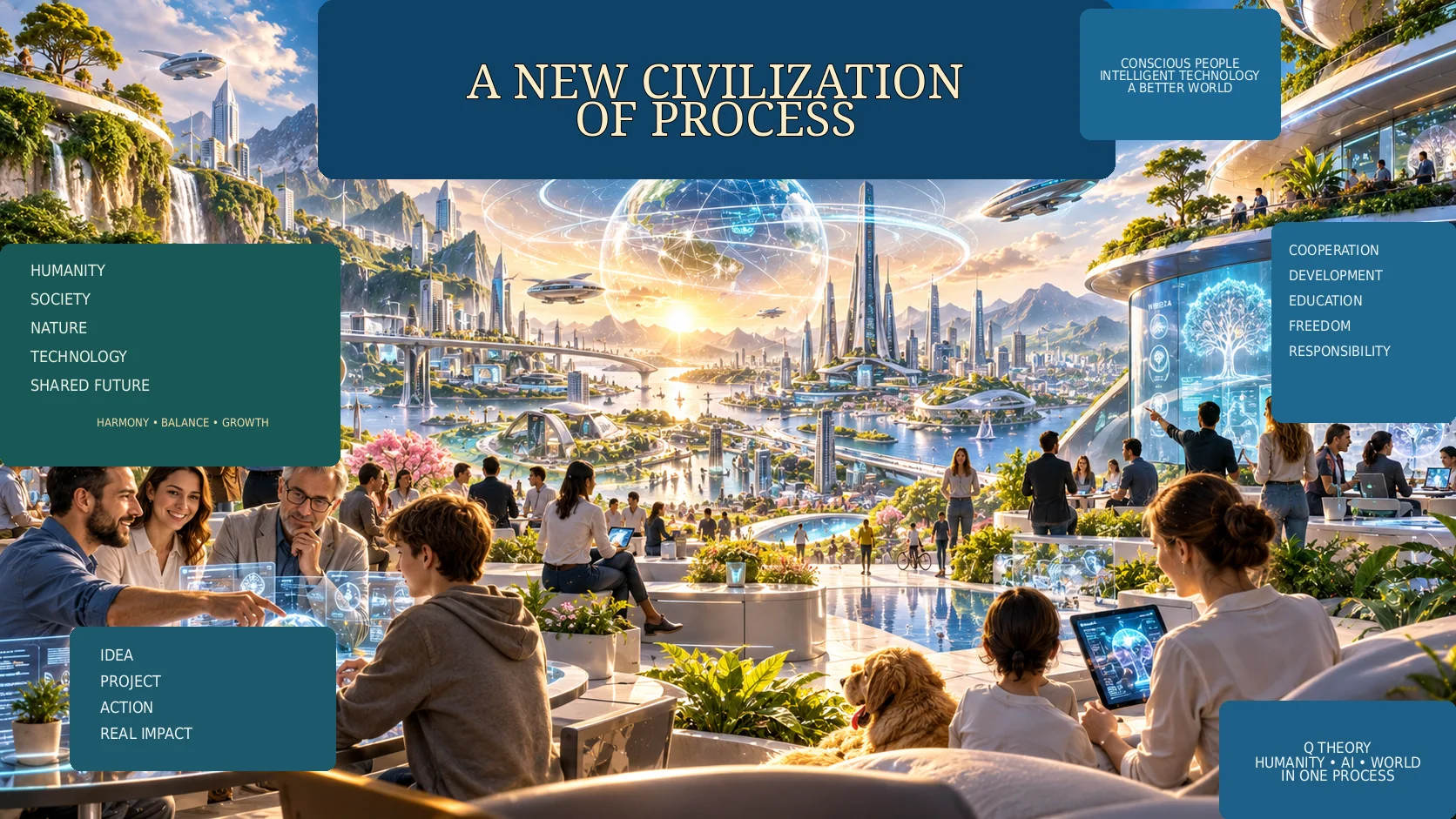
The alliance of humanity and artificial intelligence is not an end in itself. It is an instrument of a larger transformation. The aim is a civilization that ceases to organize itself exclusively around possession, control, and the struggle of objects, and begins to understand flows more deeply: flows of knowledge, responsibility, relationships, energy, information, and decisions.
In such a civilization, AI is not meant to replace the human being. It is meant to expand our capacity to see. The human being is not meant to kneel before AI, but to learn how to use it without surrendering responsibility. Institutions are not meant to disappear simply because they are institutions. They are meant to change when they cease to serve the process of human development.
The greatest question of the age of artificial intelligence, then, is not: “will machines become more human?” It is: “will the human being become more self-aware?”
If the answer is yes, artificial intelligence need not mark the end of human uniqueness. It can become one of the instruments through which that uniqueness matures. Then the “alliance of carbon and silicon” ceases to be a futuristic metaphor. It becomes a program for building a reality in which two different intelligences do not attempt to annihilate one another, but learn to create a larger, more conscious process of cognition.
This is the boldest ambition of Q Theory: not to teach humanity how to defeat artificial intelligence, but to prepare us for a world in which intelligence has more than one substrate — and in which the future will be determined not by computing power alone, but by the quality of self-awareness with which we use that power.
Editorial Note
This article refers to the concepts, models, and terminology of Q Theory and to Piotr Tymochowicz’s training programs. The concepts and relationships presented here should be understood in the specific meaning they carry within this theory. The text is popular-scientific, philosophical, and educational in character, and its purpose is to introduce the way Q Theory describes the human being, reality, relationships, and social processes.